
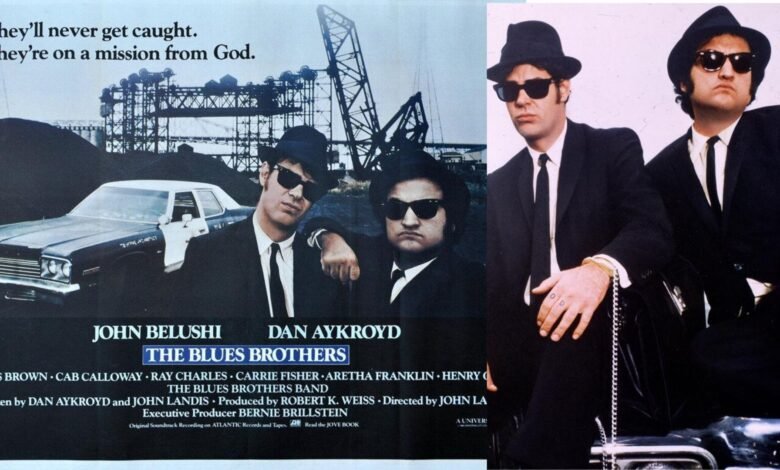
The Blues Brothers is one of those rare films where comedy, live music, car chases, and Chicago mythology collide without losing their identity. Released in 1980 and built around John Belushi and Dan Aykroyd, the movie follows Jake and Elwood Blues as they attempt to reunite their old band and raise money to save the Catholic orphanage where they grew up. The result is a musical comedy that became far more influential than its original reception suggested.


What Is the Movie About?
At its core, The Blues Brothers is a road movie disguised as a concert film. Jake, recently released from prison, returns to Chicago and discovers that the orphanage faces a serious financial problem. He and Elwood decide to get their former band back together, perform a series of shows, and raise the money needed to keep the institution open.
That simple objective creates an increasingly chaotic journey. The brothers attract the attention of police, antagonize a country-and-western band, encounter a mysterious woman determined to kill Jake, and leave a trail of spectacular property damage. The humor comes partly from the contrast between their calm, deadpan attitude and the destruction surrounding them.
Jake and Elwood Blues
Belushi plays Jake with swagger and physical comedy, while Aykroyd gives Elwood a quieter, more controlled presence. Their black suits, hats, sunglasses, and deliberately restrained behavior became the visual signature of the characters.
The pair had already developed the Blues Brothers act through Saturday Night Live, where the characters began as part of a musical-comedy performance. The film expanded that idea into a feature-length story and surrounded the comedians with genuine music legends.
The Music Makes the Film Special
The Blues Brothers stands apart from ordinary music comedies because its soundtrack is not simply background decoration. The film puts soul, rhythm and blues, gospel, and blues traditions at the center of the story.
Aretha Franklin, James Brown, Ray Charles, Cab Calloway, and John Lee Hooker appear in memorable musical sequences. The Library of Congress describes the movie as a tribute to Chicago, soul, and R&B, highlighting appearances by Franklin, Calloway, and Charles.
The performances also introduce younger audiences to artists whose careers had begun decades earlier. Rather than treating these musicians as nostalgic cameos, the film gives them room to perform.
| Element | Why it matters |
|---|---|
| John Belushi | Provides Jake’s physical comedy and rebellious energy |
| Dan Aykroyd | Gives Elwood a restrained counterbalance |
| Chicago | Supplies the film’s distinctive setting |
| Soul and R&B | Drives the story alongside the comedy |
| Live performances | Give the movie lasting musical credibility |
| Car chases | Turn the road story into physical comedy |
💡 Pro Tip:
If you are watching The Blues Brothers for the first time, pay attention to the performers as much as the plot. The musical sequences are a gateway into classic soul and R&B, and knowing the artists makes several scenes even more rewarding.
Why the Car Chases Still Work
The film’s vehicle sequences are among its defining features. Director John Landis pushed the production toward increasingly elaborate destruction, turning Chicago streets and shopping areas into the setting for escalating comic chaos.
The chase involving the Bluesmobile became particularly famous because the action is played with such a straight face. Jake and Elwood rarely behave as though they are in a gigantic spectacle. They simply continue their mission while police cars pile up behind them.
That contrast gives the action its comic rhythm. The film does not rely only on dialogue; editing, stunt work, music, and physical destruction all contribute to the jokes.
From Saturday Night Live to a Cult Classic
The Blues Brothers grew out of the creative relationship between Belushi and Aykroyd during the early years of Saturday Night Live. Aykroyd’s enthusiasm for blues music helped shape the characters, while Belushi’s performance ability turned the act into something audiences immediately remembered.
The 1980 movie was not an instant critical triumph. Its production became known for delays, escalating costs, and a difficult shooting process. Yet its reputation changed over time. A 2024 Library of Congress publication notes that the film was initially met with outraged reviews but later came to be recognized as a classic with major cultural influence.
That evolution is central to understanding the movie’s legacy. Audiences returned to it for the music, performances, visual style, and sheer excess of its action.
Why The Blues Brothers Remains Culturally Important
The strongest argument for its lasting importance is that it connects several parts of American popular culture at once. It is a Chicago film, a comedy, a music showcase, a tribute to Black musical traditions, and a showcase for performers who had already shaped American music.
The Library of Congress added the 1980 film to the National Film Registry in 2020, recognizing it as culturally, historically, or aesthetically significant. The Registry preserves films with enduring importance to American culture rather than simply labeling them the “best” movies ever made.
That distinction matters. The movie’s value is not limited to its plot. Its musical performances, comedy style, Chicago locations, and larger-than-life production have helped it remain recognizable more than four decades after release.
A Film Built Around Real Musical History
Another reason The Blues Brothers continues to attract new viewers is its respect for the musicians it features. It places established artists alongside comedy performers without making the musicians feel secondary.
This approach helped make the soundtrack a major part of the experience. Songs associated with the movie became closely connected with the characters, while the performances preserve a snapshot of American popular music at a particular moment.
📌 Key Takeaway:
The Blues Brothers works because its biggest strengths reinforce one another. The comedy creates momentum, the Chicago setting supplies character, the action creates spectacle, and the music gives the movie a cultural foundation that extends beyond its story.
Frequently Asked Questions
Is The Blues Brothers based on a true story?
No. The plot is fictional, although the characters emerged from a real musical-comedy act created by Dan Aykroyd and John Belushi on Saturday Night Live. The movie also draws heavily on real American music history by featuring major soul, blues, and R&B performers.
Who are the two main characters?
The central characters are Jake Blues, played by John Belushi, and Elwood Blues, played by Dan Aykroyd. They are brothers who set out to reunite their former band and raise money to help save the orphanage where they were raised.
Why is The Blues Brothers considered a classic?
Its combination of comedy, live musical performances, memorable characters, Chicago locations, and ambitious car chases gives it a distinctive identity. Its preservation in the National Film Registry also reflects its broader cultural and historical significance.
What kind of music is featured in the film?
The movie draws heavily from blues, soul, rhythm and blues, gospel, and related American musical traditions. Performers including Aretha Franklin, Ray Charles, James Brown, Cab Calloway, and John Lee Hooker contribute to its musical character.
Is The Blues Brothers worth watching today?
Yes, especially for viewers who enjoy classic comedy and American music. Some production choices and humor reflect the era, but the performances, soundtrack, visual style, and ambitious action sequences remain distinctive. It is also a useful introduction to several influential musicians.
Final Thoughts
The Blues Brothers has survived because it is much more than a comedy about two men in sunglasses. Its story gives the music a purpose, its music gives the characters depth, and its outrageous action gives the whole film a memorable physical scale. More than four decades later, it remains a vivid example of how cinema can preserve musical history while entertaining an audience.






One Comment