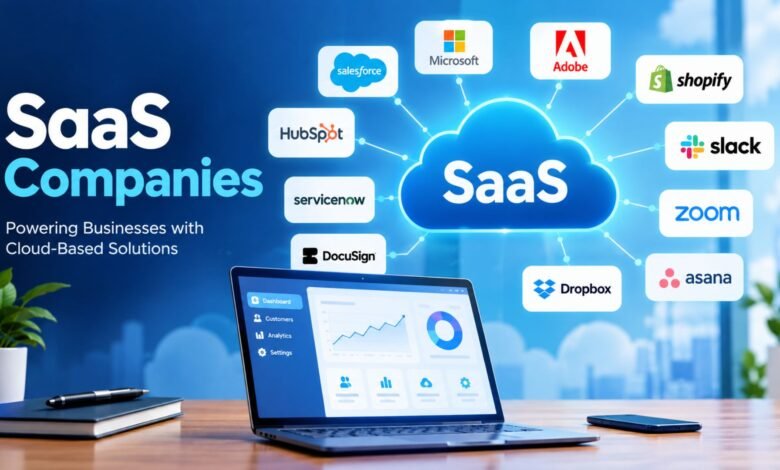
SaaS companies deliver software through the internet rather than requiring customers to install and maintain traditional software on local machines. The model has become central to business technology, covering everything from customer relationship management and accounting to project management, cybersecurity, communication, and artificial intelligence.
The basic idea is straightforward: a provider operates the application and underlying infrastructure, while customers access the software through a web browser, mobile application, or another supported interface. NIST defines Software as a Service as a cloud model in which customers use applications running on a cloud infrastructure without managing the underlying servers, operating systems, storage, or network infrastructure.


For businesses evaluating software, understanding how this model works can make it easier to compare vendors, pricing structures, security practices, and long-term value.
What Are SaaS Companies?
SaaS companies are software businesses that provide applications as an ongoing service. Instead of selling a program that customers install once, the provider typically hosts and maintains the application while customers pay for access.
Common commercial models include monthly or annual subscriptions, usage-based pricing, per-user plans, and tiered packages. Some providers also offer free plans or limited trials to let potential customers evaluate the product before purchasing.
The category is broad. A SaaS provider might serve consumers, small businesses, large enterprises, developers, marketing teams, financial departments, or highly specialized industries.
How the SaaS Model Works
A typical SaaS arrangement has several layers. The provider develops the application, operates its cloud environment, manages updates, monitors availability, and handles much of the technical maintenance. The customer configures the product for its needs and controls the information and workflows stored within the application according to the service agreement.
This structure reflects the broader cloud computing model described by NIST, which emphasizes convenient, on-demand access to shared computing resources.
| SaaS Category | Typical Use | Common Buyers |
|---|---|---|
| CRM | Sales and customer management | Sales and service teams |
| Project Management | Planning and collaboration | Businesses and agencies |
| Accounting | Financial records and reporting | Small businesses and finance teams |
| Marketing | Campaigns and automation | Marketing departments |
| Communication | Messaging and meetings | Remote and hybrid teams |
| Cybersecurity | Identity and security management | IT and security teams |
Why Businesses Choose SaaS Companies
One major advantage is accessibility. Employees can generally use cloud applications from different locations and devices without maintaining a separate software installation on every machine.
Another benefit is faster deployment. Instead of purchasing infrastructure and performing extensive installation work, an organization can often create accounts, configure permissions, import data, and begin using a cloud application relatively quickly.
Software maintenance can also become more centralized. Providers can release updates, security fixes, and new functionality through their hosted environment. That can reduce the operational burden placed on customers, although businesses still need to evaluate how vendors handle security, data protection, uptime, and changes to the product.
Scalability is another consideration. A growing organization may be able to add users or increase usage without replacing an entire software environment. The actual cost and ease of scaling depend heavily on the vendor’s pricing and architecture.
Major Types of SaaS Companies
The SaaS industry is not a single market. It consists of many specialized categories designed around particular business problems.
CRM platforms help organizations manage leads, customer records, sales pipelines, and service interactions. Project-management applications focus on tasks, schedules, collaboration, and workflow visibility. Accounting platforms address bookkeeping, invoicing, expenses, payroll-related processes, and financial reporting.
Marketing software can cover email campaigns, customer journeys, analytics, search optimization, advertising, and content workflows. Human-resources platforms may handle recruiting, employee records, benefits administration, performance management, and workforce planning.
There is also a growing group of AI-enabled applications. These products may automate repetitive work, analyze information, generate content, summarize documents, or support decision-making. Gartner reported in 2026 that agentic AI could significantly change the economics of enterprise application software by shifting attention from user interaction with individual applications toward completed outcomes.
Enterprise vs. Small-Business SaaS
Enterprise-oriented providers often emphasize administration, security controls, integrations, compliance requirements, data governance, and support for large numbers of users. Small-business products may prioritize affordability, ease of setup, simplicity, and quick adoption.
Neither model is automatically better. The right choice depends on the organization’s size, technical requirements, budget, regulatory environment, and expected growth.
💡 Pro Tip:
Before comparing SaaS vendors, write down the three workflows the software must improve. Then evaluate each provider against those workflows rather than choosing the product with the longest feature list.
How to Evaluate SaaS Companies
A polished interface is not enough to justify a software purchase. Buyers should examine the complete service.
Start with functionality. Determine whether the platform solves the actual problem rather than simply offering attractive features. Next, review integrations. A useful application should fit into the existing technology stack instead of creating another isolated data source.
Security deserves equal attention. Review authentication options, access controls, encryption practices, audit capabilities, incident-response procedures, and relevant compliance information. Businesses should also understand where data is stored and how it can be exported.
Pricing requires careful examination. A low starting price can become expensive as users, storage, automation, or premium features are added. Look beyond the advertised plan and calculate the likely total cost over the period you expect to use the platform.
Vendor stability also matters. A provider’s product roadmap, customer support, documentation, financial position, and approach to data portability can affect the long-term value of the purchase.
Gartner’s 2026 research on SaaS management highlights another challenge: organizations can accumulate applications, increase spending, and lose visibility as software usage expands.
📌 Key Takeaway:
The strongest SaaS purchase is not necessarily the platform with the most features. It is the service that solves the right business problem, integrates with existing systems, protects important data, and remains financially practical as usage grows.
Frequently Asked Questions
What does SaaS stand for?
SaaS stands for Software as a Service. It describes a software delivery model in which customers access applications operated by a provider through a network, commonly the internet. Customers generally do not manage the underlying servers, storage, operating systems, or other infrastructure supporting the application.
How do SaaS companies make money?
Most use recurring revenue models such as monthly or annual subscriptions. Other approaches include usage-based charges, per-seat pricing, tiered plans, enterprise contracts, and combinations of free and paid features. Pricing varies substantially by product category and customer type.
What are the main benefits of SaaS?
The model can provide convenient access, centralized maintenance, faster deployment, easier collaboration, and flexible purchasing options. However, benefits depend on the specific provider, and customers still need to assess security, reliability, integrations, pricing, and data portability before committing.
Are SaaS products secure?
SaaS security varies by provider and implementation. Customers should examine authentication, authorization, encryption, monitoring, incident response, compliance documentation, and administrative controls. Security is a shared responsibility: using a reputable provider does not remove the customer’s responsibility for account security and appropriate configuration.
What is the future of SaaS?
SaaS is likely to become increasingly connected with artificial intelligence, automation, data platforms, and integrated workflows. Gartner’s recent research suggests AI agents could reshape traditional application models by emphasizing outcomes rather than requiring users to work manually across many separate interfaces.
The best SaaS companies will therefore need to do more than move software into the cloud. They will need to deliver measurable business value, maintain strong security and reliability, integrate with other systems, and adapt as customers expect more automation.
For buyers, the practical lesson is simple: compare software based on the problem it solves, the total cost of ownership, the quality of its security controls, and its ability to fit into existing workflows. As cloud software and AI continue to evolve, thoughtful evaluation will remain more valuable than choosing a platform simply because it is popular.
Conclusion
SaaS companies have changed how businesses access, manage, and scale software. From CRM and accounting to marketing, collaboration, cybersecurity, and AI-powered tools, the SaaS model gives organizations flexible access to services without managing the underlying infrastructure themselves. However, choosing the right provider requires more than comparing features. Businesses should consider security, integrations, pricing, reliability, scalability, and long-term value. As cloud technology and AI continue to develop, the most useful SaaS solutions will be those that solve real business problems while making everyday workflows more efficient.