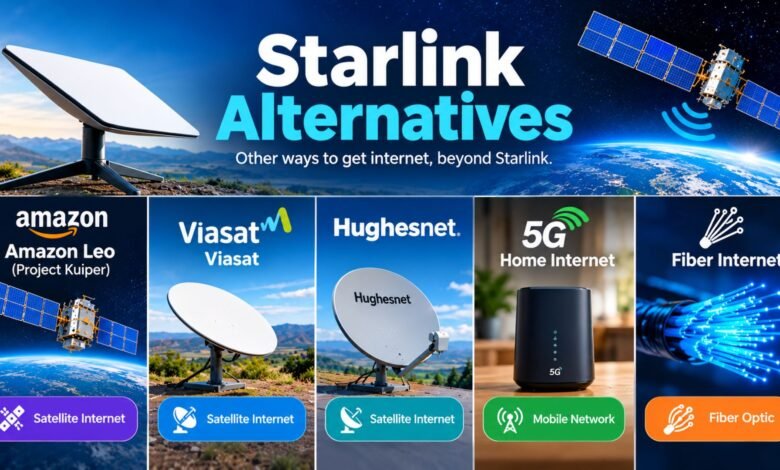
Starlink has changed expectations for satellite internet, particularly for people in rural areas where cable and fiber are unavailable. But it is not the only option. The best starlink alternatives depend on where you live, how much data you use, whether you need mobility, and whether you prefer satellite or a terrestrial connection.
For households in the USA and UK, choices now range from established satellite providers such as HughesNet and Viasat to newer low-Earth-orbit networks such as Eutelsat OneWeb and Amazon Leo. Fixed wireless, 5G home internet, cable, and fiber can also make more sense when they are available.


Why Look for Starlink Alternatives?
Starlink uses a large low-Earth-orbit satellite constellation to provide broadband with substantially lower latency than traditional geostationary satellite systems. Starlink itself reports typical land-based latency of roughly 25–60 milliseconds and download speeds that can vary significantly by location and service plan.
That performance makes Starlink attractive for streaming, video calls, remote work, and online gaming. However, availability, local congestion, equipment requirements, weather conditions, installation needs, and monthly pricing can all affect the decision.
Some people also simply want a provider with a different service model. For businesses, government customers, ships, aircraft, and other professional applications, alternatives may offer contracts, support arrangements, or network features that are better suited to their requirements.
Best Starlink Alternatives at a Glance
| Provider or Technology | Network Type | Best For | Main Advantage | Main Consideration |
|---|---|---|---|---|
| Amazon Leo | LEO satellite | New satellite broadband option | New-generation satellite network | Availability is still expanding |
| Eutelsat OneWeb | LEO satellite | Business, government, mobility | Global low-latency connectivity | Primarily enterprise-focused |
| HughesNet | Geostationary satellite | Rural households | Established rural coverage | Higher latency than LEO |
| Viasat | Geostationary satellite | Rural and remote users | Broad satellite footprint | Performance varies by location and plan |
| Fiber | Terrestrial | Heavy home internet use | Excellent speed and latency | Limited rural availability |
| Fixed wireless/5G | Terrestrial wireless | Suburban and rural homes | No satellite dish required | Coverage depends heavily on location |
Amazon Leo Is the Biggest Emerging Rival
Amazon Leo, formerly known as Project Kuiper, is Amazon’s low-Earth-orbit satellite internet network. Amazon says the network is designed to provide connectivity to customers and communities beyond the reach of existing networks. The company began an enterprise preview in November 2025 and has been expanding service during 2026.
Amazon’s planned customer hardware also covers different use cases. Its Leo Nano antenna is designed for download speeds of up to 100 Mbps, while Leo Pro can reach up to 400 Mbps and the enterprise-oriented Leo Ultra is designed for up to 1 Gbps downstream and up to 400 Mbps upstream. These are technology capabilities rather than guarantees of real-world residential performance.
For consumers considering starlink alternatives, Amazon Leo is worth watching because it brings another major technology company into the LEO broadband market. Availability, pricing, coverage, and final consumer plans should be checked in the user’s specific market before making a purchasing decision.
💡 Pro Tip:
If you live somewhere with fiber, cable, or reliable fixed wireless, compare those services before choosing satellite. A lower-latency terrestrial connection can be more suitable for gaming, large downloads, and multiple simultaneous users.
Eutelsat OneWeb Targets a Different Market
Eutelsat’s OneWeb network is another major LEO satellite system, but its business model differs from Starlink’s consumer-heavy approach. Eutelsat says its OneWeb constellation contains more than 600 satellites operating about 1,200 kilometers above Earth and supports connectivity across land, sea, and air.
OneWeb is particularly relevant to enterprises, governments, telecommunications companies, maritime operators, and aviation. It offers high-speed, low-latency connectivity and can integrate with existing infrastructure.
That makes OneWeb one of the strongest starlink alternatives for organizations that need managed connectivity rather than a straightforward residential broadband subscription.
Its position is also becoming more significant. In September 2026, Eutelsat announced a €1 billion agreement with Airbus for 229 additional satellites, part of a broader expansion intended to strengthen its LEO network through 2034.
HughesNet and Viasat Remain Established Choices
HughesNet and Viasat are older names in satellite broadband and remain relevant where terrestrial broadband is limited. Their geostationary satellite architectures differ from Starlink and OneWeb, generally resulting in higher latency.
That distinction matters. A connection can provide adequate download speeds for browsing and streaming while still feeling slower during latency-sensitive activities such as competitive gaming or interactive applications.
Viasat also highlights differences between its service and competing satellite providers, including unlimited-data offerings and month-to-month options on certain plans. However, advertised speeds and availability vary by service and location, so customers should check the current offer for their address.
For someone comparing starlink alternatives, HughesNet and Viasat can therefore make sense when availability is the deciding factor rather than raw latency.
Don’t Ignore Fiber, Cable, and Fixed Wireless
Satellite is not automatically the best solution simply because a property is rural. If fiber, cable, fixed wireless, or 5G home internet is available, compare it carefully.
Fiber generally offers excellent latency, strong upload performance, and high capacity. Cable can also provide fast residential service where infrastructure exists. Fixed wireless can be particularly attractive in rural areas served by a nearby tower because it can avoid satellite-related latency and dish installation.
The practical rule is simple:
choose the best connection available at your address, not the most famous technology.
Starlink itself notes that residential availability and pricing can vary by address and that service plans may differ between locations. Its current US offerings include residential plans with different speed tiers, while exact availability depends on the service address.
How to Choose the Right Alternative
Start with availability. A provider that looks excellent on paper is irrelevant if its service cannot reach your property.
Next, compare latency rather than looking only at download speed. A 200 Mbps connection with high latency can feel very different from a similarly fast connection with a much shorter response time.
Data policies are another consideration. Check whether the plan includes unlimited data, priority data, traffic management, or restrictions after a specific allowance.
Finally, consider installation and equipment. Satellite services generally require outdoor hardware with a suitable view of the sky, while fiber and cable rely on existing physical infrastructure.
For mobile users, such as RV travelers or maritime operators, mobility support can be more important than residential pricing. Starlink, for example, separates fixed residential service from Roam plans designed for travel and mobile use.
📌 Key Takeaway: The strongest starlink alternatives are not identical competitors. Amazon Leo and OneWeb represent the next generation of LEO satellite connectivity, while HughesNet and Viasat remain established satellite choices. Where available, fiber, cable, and fixed wireless may be even better for everyday home internet.
Frequently Asked Questions
What is the best alternative to Starlink?
There is no single winner for every location. Amazon Leo is an important emerging LEO competitor, while OneWeb is especially relevant to enterprise and government users. HughesNet and Viasat remain established satellite choices. For households with access to fiber or reliable fixed wireless, those terrestrial options may provide better latency and capacity.
Is Amazon Leo better than Starlink?
Amazon Leo is designed as a competing LEO satellite network, but a universal comparison is premature because availability, consumer pricing, coverage, and real-world performance depend on market and rollout stage. Amazon began wider service expansion in 2026, so customers should compare actual local offerings rather than relying only on announced technical capabilities.
Are there Starlink alternatives for rural areas?
Yes. Rural customers can consider HughesNet, Viasat, emerging LEO services, fixed wireless, 5G home internet, or fiber if infrastructure reaches the property. The best choice depends on local coverage, terrain, network congestion, data policies, installation requirements, and the type of online activities performed.
Is OneWeb available for regular home users?
OneWeb is primarily positioned around enterprise, government, telecommunications, maritime, aviation, and other professional connectivity applications rather than the typical direct-to-consumer home broadband model. Its LEO network provides global connectivity, but residential customers should check whether a local partner offers an appropriate service.
What should I compare before switching providers?
Compare monthly cost, equipment fees, installation, download and upload performance, latency, data policies, availability at your exact address, contract terms, customer support, and expected peak-hour performance. For remote households, also consider whether the provider has a practical backup option during outages or severe weather.
Final Thoughts
The satellite broadband market is becoming more competitive, but the right choice depends less on brand recognition than on the connection available at your property. Starlink remains a strong option for many remote users, while Amazon Leo could become a significant competitor as its network expands. OneWeb serves a different professional segment, and HughesNet and Viasat continue to provide established satellite coverage.
For buyers researching starlink alternatives, the smartest approach is to compare the technologies available at the exact address and prioritize latency, reliability, data policies, total cost, and actual availability. A newer satellite network may be exciting, but the best internet connection is the one that fits the user’s location and daily workload.