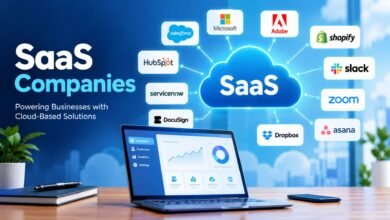
Business-to-business SaaS describes cloud software sold by one organization to another. Instead of installing and maintaining software on company-owned infrastructure, customers access an application online while the provider operates the software and underlying systems. The model covers CRM, accounting, project management, cybersecurity, marketing, analytics, HR and collaboration.
For buyers and founders, the useful question is how the model works and where it creates value.


What Is Business-to-Business SaaS?
B2B SaaS stands for business-to-business software as a service. The defining distinction is the customer: the software is designed and sold to organizations rather than primarily to individual consumers.
The provider hosts and maintains the application, while customers normally access it through a browser, mobile app or another supported interface. NIST describes SaaS as using provider-run applications on cloud infrastructure without customers managing the underlying servers, operating systems, storage and network infrastructure.
A product might serve a five-person agency, a manufacturer with hundreds of employees or a multinational enterprise. It can be specialized or broad, but its commercial purpose is to help another organization perform work, manage information, reduce manual effort or make decisions.
How Does B2B SaaS Work?
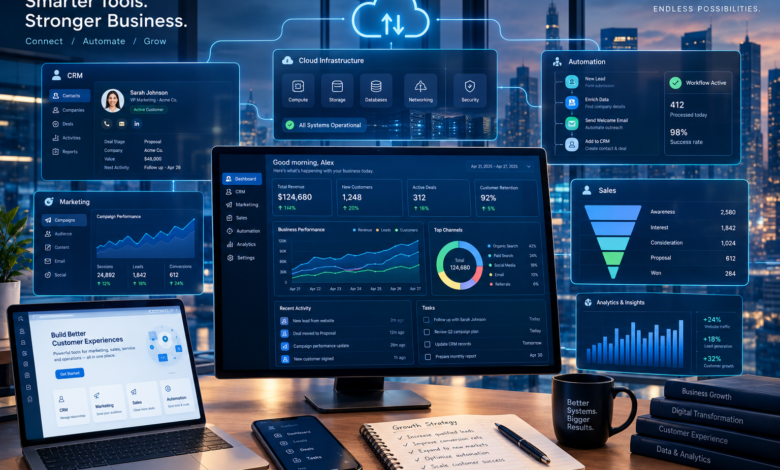
A typical arrangement connects the provider, cloud environment and customer organization.
The provider develops the application, operates its infrastructure, releases updates and handles technical operations. The customer creates accounts, configures workflows, assigns permissions and uses the application for business activities. Depending on the service, customers may also connect the software with CRM systems, accounting platforms, communication tools, data warehouses or other applications.
Subscription pricing is common. Providers may charge monthly or annually, use per-user pricing, offer usage-based billing, or combine several approaches. Microsoft notes that SaaS businesses commonly use recurring subscriptions while flexible pricing models can align costs with usage or customer value.
| Software category | Typical business use | Common users |
|---|---|---|
| CRM | Leads, customers and sales pipelines | Sales and service teams |
| Project management | Tasks, schedules and collaboration | Operations and project teams |
| Accounting | Invoicing, expenses and reporting | Finance teams |
| Marketing automation | Campaigns and customer journeys | Marketing teams |
| Cybersecurity | Identity, access and security controls | IT and security teams |
| Analytics | Reporting and business intelligence | Managers and analysts |
Why Do Businesses Use B2B SaaS?
The appeal is partly operational. A company can adopt a hosted application without purchasing and maintaining the complete infrastructure required to run conventional software internally. The provider can also deliver updates centrally, which can simplify maintenance for customers. The U.S. General Services Administration describes SaaS as software delivered over the internet, typically on a subscription or pay-as-you-go basis, with the provider managing the application and infrastructure.
Accessibility is another factor. Employees in different locations can often use the same cloud application, subject to the provider’s access controls and the organization’s policies.
Scalability can also matter. A growing company may add users, features or usage capacity without replacing an entire software installation.
A strong platform can centralize information, automate repetitive tasks and connect processes that previously depended on spreadsheets or disconnected tools.
💡 Pro Tip: Before comparing B2B SaaS vendors, write down the three business workflows the software must improve. Use those workflows as evaluation criteria instead of choosing the platform with the longest feature list.
Business SaaS vs. Traditional Software
Traditional business software may require customers to install applications, maintain servers or coordinate major upgrades themselves. SaaS moves much of that operational responsibility to the provider.
SaaS also differs from B2B as a commercial category. B2B describes who buys the product; SaaS describes how software is delivered. A product can therefore be B2B SaaS, B2C SaaS, or another type of software depending on its customers and delivery model. Microsoft makes the same distinction in its SaaS architecture guidance, noting that SaaS products can target businesses or consumers.
What Should Buyers Check Before Choosing a Platform?
A serious evaluation should go beyond a product demonstration.
First, examine functionality. Does the platform solve the actual problem, or are impressive features distracting from a basic requirement? Next, review integrations. Business software rarely operates alone, so compatibility with existing systems can determine whether implementation is smooth or frustrating.
Security deserves close attention. Buyers should review authentication, authorization, encryption, monitoring, administrative controls, incident response and relevant compliance documentation. They should also understand how data is stored, exported and deleted.
Pricing deserves the same scrutiny. Calculate expected costs based on users, usage, premium features, implementation and likely growth. A low starting price can become substantially different once an organization expands.
Vendor reliability matters too. Documentation, customer support, product development, contractual terms and data portability can affect the relationship long after the initial purchase.
What Makes a SaaS Product Successful?
A successful product needs more than cloud hosting. It needs a clear business problem, an understandable value proposition and an experience that customers can adopt without excessive friction.
For providers, scalability is particularly important. Microsoft notes that SaaS solutions often use multitenant architectures, although multitenancy is an architectural choice rather than a requirement that defines SaaS. Providers also need to manage customer isolation, security, reliability and compliance as usage grows.
Google Cloud identifies AI as an important part of current SaaS development, alongside the broader cloud model in which providers operate centrally hosted applications.
📌 Key Takeaway: B2B SaaS is more than software sold by subscription. It combines a business customer, cloud-based delivery and an ongoing service relationship. For buyers, value depends on functionality, security, integrations, pricing and reliability. Providers also need a clear business problem, usable onboarding and reliable operations.
Frequently Asked Questions
What does B2B SaaS mean?
Business-to-business SaaS means software as a service sold to organizations. A provider hosts software and sells access to businesses, commonly through subscriptions or other recurring pricing models.
What are examples of business SaaS?
Examples include CRM systems, accounting platforms, project-management tools, HR software, marketing automation platforms, cybersecurity services and business analytics applications.
How do SaaS companies make money?
They commonly use monthly or annual subscriptions, per-user pricing, usage-based billing, tiered plans, enterprise contracts or combinations of these models.
Is B2B SaaS the same as cloud software?
They overlap but are not identical terms. SaaS is a specific software delivery model, while cloud software can describe a wider range of applications and services. B2B identifies the type of customer being served.
Is B2B SaaS secure?
Security varies by provider. Businesses should review access controls, authentication, encryption, monitoring, incident response, compliance information and data-handling practices before adopting a platform.
Conclusion
B2B SaaS has become a central way for organizations to access business software without managing the underlying infrastructure themselves. Its value comes from more than online access: the right platform can improve workflows, connect systems, automate repetitive work and support growth.
For buyers, careful evaluation remains essential. Compare the product against real business requirements, examine security and integrations, calculate the full cost of ownership and understand how the provider handles your data. As AI and cloud technology continue to reshape business software, those fundamentals will remain useful for separating practical tools from products that simply have impressive feature lists.