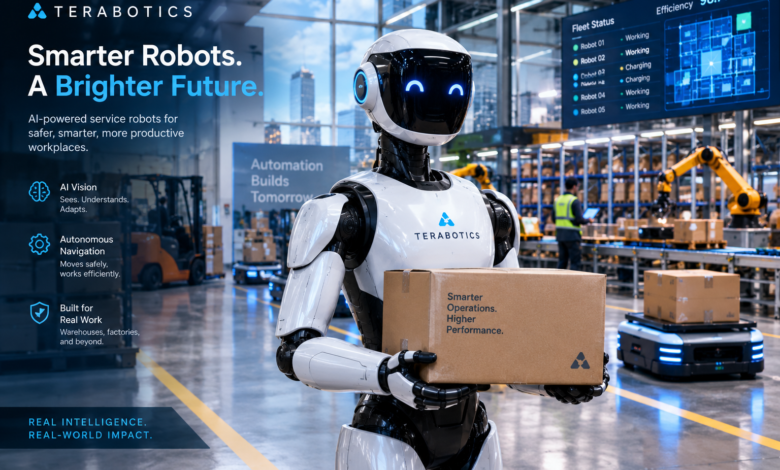
Richtech Robotics is a U.S. robotics and artificial intelligence company developing embodied AI systems for commercial and industrial applications. The company has attracted attention because its robots are designed for real-world tasks rather than laboratory demonstrations, spanning hospitality, cleaning, logistics and emerging industrial automation.
For readers searching for Richtech Robotics, the key areas to understand are its robot portfolio, business model, recent financial performance and the company’s shift toward recurring robotics services. Its latest filings and announcements also show a stronger emphasis on AI-native systems and integrated automation.


What Is Richtech Robotics?
Richtech Robotics Inc. was established in Nevada in 2016 and became a publicly traded company in 2023. Its Class B common stock trades on Nasdaq under the symbol RR. The company describes itself as an AI and robotics technology business focused on improving the efficiency and productivity of U.S. businesses through embodied AI.
The company’s strategy has increasingly moved beyond selling individual machines. Its filings describe three broad business pillars: commercial, industrial and data services. It also generates revenue through product sales, event services and Robotics-as-a-Service, or RaaS.
That combination matters because robotics businesses can face a difficult balance between hardware sales and recurring revenue. RaaS allows customers to access robotic systems with ongoing maintenance and technical support under contractual arrangements.
Key Robots and Applications
The company’s portfolio covers several different operating environments. ADAM is one of its best-known platforms and is associated with beverage preparation and foodservice automation. The company has also demonstrated cleaning robots, warehouse systems and newer industrial platforms.
In 2026, Richtech highlighted DEX, an AI-enabled humanoid robot, and Titan 440, an autonomous mobile robot, as part of an integrated industrial robotics ecosystem. It has also showcased DUST-E S cleaning technology and newer pallet-jack automation for warehouse environments.
| Area | Example platform | Intended application |
|---|---|---|
| Foodservice | ADAM | Beverage and hospitality automation |
| Cleaning | DUST-E S | Commercial cleaning tasks |
| Humanoid robotics | DEX | Industrial and interactive automation |
| Mobile automation | Titan 440 | Autonomous movement and industrial workflows |
| Warehouse automation | Pallet-jack systems | Material handling |
The broader idea is to create robotic systems that can operate alongside people while taking over repetitive or operationally demanding tasks.
How the Business Model Works
One of the more significant developments is the expansion of Robotics-as-a-Service. Rather than requiring a customer to purchase a complete robotic system upfront, RaaS can provide access through recurring payments that include equipment and support.
According to the company’s June 2026 quarterly filing, RaaS revenue for the first nine months of fiscal 2026 reached about $1.1 million, up from roughly $0.4 million in the comparable period. Total revenue rose from $3.6 million to $3.9 million over the same period.
The shift also appears in product sales. Product revenue declined during the nine-month period while RaaS and event-service revenue increased. That suggests the company is trying to build a revenue mix that relies less heavily on one-time hardware transactions.
💡 Pro Tip: When evaluating a robotics company, look beyond the number of robots it demonstrates. Check how customers pay, how much revenue comes from recurring services, and whether deployments are translating into sustainable contracts.
AI Development and Embodied Robotics
AI is increasingly central to the company’s product strategy. Its 2026 filing says the business is investing in artificial intelligence, system autonomy and human-machine interaction. It also identifies NVIDIA-based AI computing platforms and robotics software frameworks as part of its development approach.
This is important because physical robots require more than mechanical movement. A useful autonomous system needs perception, decision-making, navigation, safety controls and the ability to respond to changing environments.
Richtech has also been positioning its systems for commercial environments where reliability and practical deployment matter. Its investor materials say the company has deployed systems across 37 states and 80 cities, although deployment figures are company-reported and can change over time.
Financial Picture and Recent Developments
The latest SEC filing provides a useful snapshot. For the nine months ended June 30, 2026, revenue was $3.945 million, compared with $3.601 million a year earlier. Gross profit was $1.497 million, while research and development expense increased to $3.144 million from $1.337 million.
The company also reported a net loss of $20.41 million for the nine-month period. A major factor in the reported results was a significant impairment of certain legacy software-related intangible assets during the June quarter.
These numbers show why the company should be viewed as an emerging technology business rather than a mature robotics manufacturer. Revenue remains relatively small, while research, development and deployment costs can be substantial.
Why the Company Is Getting Attention
Several developments have put the company on the radar of technology and market watchers.
First, it is expanding from service robots into industrial automation and humanoid robotics. Second, its RaaS model is becoming a larger part of revenue. Third, the company has continued investing in AI systems designed for real-world robotic applications.
In August 2026, the board authorized a program to repurchase up to $12 million of Class B shares through August 2027. That is a corporate action, not a guarantee of future share performance, and investors should distinguish company announcements from independent assessments of the stock.
📌 Key Takeaway: Richtech Robotics is building a business around AI-powered robots for commercial and industrial work, with increasing emphasis on recurring service revenue. Its progress should be judged through actual deployments, revenue mix, R&D spending and financial results rather than robot demonstrations alone.
Frequently Asked Questions
What does Richtech Robotics make?
The company develops AI-driven robotic systems for areas including hospitality, cleaning, logistics and industrial automation. Its portfolio includes ADAM, DUST-E S, DEX and Titan 440.
Is Richtech Robotics a public company?
Yes. Richtech Robotics Inc. is publicly traded on Nasdaq, where its Class B common stock trades under the ticker RR.
What is Robotics-as-a-Service?
Robotics-as-a-Service, or RaaS, lets customers use robotic equipment under ongoing contracts that can include maintenance and technical support rather than purchasing the equipment outright.
Is Richtech Robotics profitable?
The company reported a net loss of $20.41 million for the nine months ended June 30, 2026. Its financial results therefore show that it was not profitable for that reporting period.
Where is Richtech Robotics based?
The company is headquartered in Las Vegas, Nevada, according to its SEC filings and investor materials.
Conclusion
The company sits at the intersection of AI, automation and the growing service-robotics market. Its move toward RaaS, broader industrial applications and AI-native platforms gives the business several areas to watch. At the same time, its financial losses and continuing R&D requirements show that commercialization remains an important part of the story.
For anyone researching the company, the most useful approach is to follow verified company filings, deployment progress, recurring revenue and product development together rather than relying on headlines about individual robots.