Artificial turf has become a practical alternative to natural grass for homeowners, businesses, sports facilities and other outdoor spaces. It provides a consistently green surface without mowing, seeding or regular lawn irrigation, but it is not maintenance-free and does not suit every property.
The right choice depends on climate, drainage, foot traffic, appearance, installation requirements and how the space will be used. Before replacing a natural lawn, it helps to understand both the everyday advantages and the less obvious trade-offs.


What Is Artificial Turf?
Artificial turf is a synthetic surface designed to resemble natural grass. It typically consists of plastic grass-like blades attached to a backing, with some installations using infill to help support the blades and provide weight or cushioning.
Modern products vary considerably. Some are designed primarily for residential landscaping, while others are manufactured for sports fields, playgrounds, commercial properties or areas used by pets.
Unlike living grass, artificial turf does not grow. That means there is no mowing or fertilizing, and its appearance is less affected by seasonal dormancy. However, the underlying surface still needs to be properly prepared, and the finished installation requires periodic cleaning and inspection.
Artificial Turf Benefits
The biggest attraction is predictable appearance with less routine lawn work. A properly installed surface can remain visually consistent through periods when natural grass would become thin, brown or damaged.
Common benefits include:
- No routine mowing
- No grass seed or regular fertilizing
- Lower routine irrigation requirements
- Consistent appearance throughout the year
- Good performance in heavily used areas
- Less mud after rain when drainage is properly designed
For busy households, eliminating weekly mowing can be particularly convenient. Artificial surfaces can also make sense in small courtyards, rooftop areas and locations where growing healthy grass is difficult.
Water savings can be another consideration, particularly in regions where maintaining natural grass requires substantial irrigation. However, this benefit should not be treated as absolute because synthetic surfaces may still require water for cleaning or cooling in hot conditions.
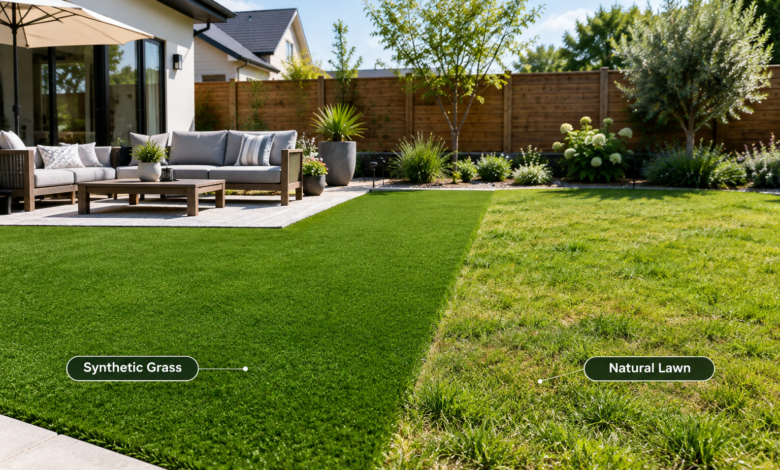
Artificial Turf vs. Natural Grass
The comparison is more complicated than simply deciding which surface looks better.
| Factor | Artificial Turf | Natural Grass |
|---|---|---|
| Mowing | Not required | Regularly required |
| Irrigation | Usually limited | Often required |
| Fertilizer | Not required for the surface | May be required |
| Appearance | Consistent | Changes with season and conditions |
| Heat | Can become very hot | Generally cooler |
| Wildlife value | Limited | Can support insects and soil organisms |
| Drainage | Depends heavily on installation | Soil and roots can support infiltration |
| End of life | Synthetic material requires disposal | Can be removed and replanted |
Natural grass has environmental functions that synthetic surfaces cannot replicate. Living turf has roots and soil that can help slow runoff, support soil processes and provide habitat. Research and extension guidance also indicate that synthetic surfaces can become substantially hotter than natural grass under strong sunlight.
Does Artificial Turf Get Hot?
Yes. Heat is one of the most important considerations for anyone installing artificial turf in a sunny climate.
Synthetic surfaces can become much hotter than surrounding natural grass because the plastic material absorbs and retains solar heat. A 2024 systematic review found that synthetic sports surfaces consistently had higher surface temperatures than natural grass, although the degree varied according to the surface and conditions.
Some products and infill systems are designed to reduce heat, but buyers should still consider shade, orientation and expected use.
💡 Pro Tip: If children or pets will regularly use the surface, inspect and compare products for heat-management features before buying. Also ask the installer how the surface is expected to behave during the hottest part of the day rather than judging samples indoors.
Drainage and Installation Matter
A quality product cannot compensate for poor preparation underneath it.
Installation normally involves preparing the ground, creating a stable base, installing the turf and securing seams and edges. Drainage needs particular attention because compacted underlying material can alter how quickly water moves through the area.
This matters after heavy rainfall and in locations where the turf is installed near buildings. Water should have a planned route away from structures rather than simply being expected to disappear through the surface.
Artificial turf can therefore reduce some lawn-care tasks while creating a different installation challenge. The condition of the base, slope, drainage design and quality of workmanship can all affect long-term performance.
How Much Maintenance Does It Need?
Artificial turf needs less routine care than many natural lawns, but “maintenance-free” is misleading.
Leaves, dirt and other debris can accumulate on the surface. Pets create another consideration because waste needs to be removed and affected areas may require cleaning. Heavy foot traffic can also flatten fibers over time.
Routine care may include:
- Removing leaves and debris
- Brushing flattened fibers
- Cleaning spills promptly
- Rinsing areas affected by dust or pet waste
- Checking seams, edges and drainage points
- Removing weeds that appear around the perimeter
The required schedule depends on use and local conditions. A lightly used residential area will not necessarily need the same attention as a busy sports surface.
Is Artificial Turf Environmentally Friendly?
There is no simple yes-or-no answer.
The absence of routine mowing, fertilizer and conventional lawn irrigation can reduce certain ongoing inputs. On the other hand, artificial turf is primarily a synthetic product with a finite service life. It also lacks the ecological functions provided by living plants and soil.
University of Florida IFAS notes concerns involving heat, stormwater runoff, wildlife habitat and eventual disposal. Some synthetic turf systems may also involve infill materials that require additional consideration.
Health and material questions can also vary by product. The National Institute of Environmental Health Sciences notes that researchers continue to examine potential exposure concerns involving substances associated with synthetic turf.
For that reason, buyers should examine the complete system rather than assuming every artificial grass product has identical characteristics.
When Does Artificial Turf Make Sense?
Artificial turf may be worth considering when consistent appearance and reduced routine lawn work are more important than maintaining a living landscape.
It can be useful for:
- Small urban yards
- High-traffic areas
- Pet areas
- Courtyards
- Certain commercial landscapes
- Sports and recreational applications
It may be less suitable where natural cooling, wildlife habitat, soil infiltration or a living landscape are major priorities.
📌 Key Takeaway: Artificial turf is best viewed as a synthetic landscaping system rather than a zero-maintenance replacement for grass. Product quality, installation, drainage, climate and intended use all influence whether it performs well.
Frequently Asked Questions
Is artificial turf better than real grass?
Neither option is universally better. Artificial turf reduces mowing and can provide a consistent appearance, while natural grass offers cooling, living soil, habitat and other environmental functions. The better fit depends on the property and priorities.
Does artificial turf need watering?
It generally does not need regular irrigation to remain green. However, water may sometimes be used to clean the surface or temporarily cool it during hot weather.
How long does artificial turf last?
Service life varies according to product quality, installation, climate, traffic and maintenance. Buyers should ask manufacturers for product-specific warranties and expected service-life information rather than relying on one universal figure.
Can artificial turf be installed over existing grass?
Installation usually requires proper ground preparation rather than simply placing synthetic turf over living grass. Existing vegetation generally needs to be removed or controlled, followed by preparation of a suitable base and drainage system.
Is artificial turf safe for pets?
Pet owners can use synthetic grass, but hygiene and drainage are important. Solid waste should be removed promptly, and areas exposed to urine or other waste should be cleaned according to the manufacturer’s recommendations.
Making the Right Choice
Artificial turf can solve a real landscaping problem when mowing, irrigation or inconsistent natural growth makes a conventional lawn impractical. Its advantages are clearest when the surface is professionally planned for the climate and intended use.
Before purchasing, look beyond the color and blade appearance. Ask about heat performance, drainage, infill, backing, warranty, cleaning requirements and end-of-life considerations. Artificial turf can be a useful long-term landscaping option, but its success depends as much on the complete installation system as on the grass-like surface itself.