The best modern home office ideas balance appearance with the way you actually work. A beautiful desk is not enough if the room creates glare, leaves cables everywhere, or gives you nowhere to store everyday essentials. A successful workspace should feel like part of the home while still giving you a clear boundary between work and personal time.
Current design inspiration is moving toward warm materials, smarter storage, layered lighting and flexible layouts rather than cold, corporate-looking rooms. UK design searches also show continued interest in practical storage and dedicated spaces, while contemporary home offices increasingly use built-in desks, natural finishes and carefully planned backgrounds.


1. Start With the Layout, Not the Decor
Before choosing artwork, paint or accessories, decide how the room needs to function.
A desk near a window can take advantage of daylight, but the screen should be positioned carefully to avoid reflections. A wall-facing desk can reduce visual distractions and create a clean background for video calls. In a compact room, a corner desk or floating workstation can provide useful working space without consuming the center of the floor.
If you have a dedicated room, consider creating separate zones for working, storage and taking breaks. This makes the office feel less like a collection of furniture and more like a deliberately designed room.
For smaller homes, an alcove, landing area or quiet corner can work surprisingly well. Houzz specifically highlights alcoves and living-room corners as practical options when a full office is unavailable.
2. Choose a Desk That Fits Your Work
The desk is the visual and functional anchor of the room. Its size should be determined by your equipment and working habits rather than by appearance alone.
A minimalist setup might need space for a laptop, monitor and notebook. Someone working with multiple screens, paperwork or creative equipment needs considerably more surface area.
Floating desks are particularly useful in smaller rooms because they leave more visible floor space underneath. L-shaped desks can work well when you need separate areas for a computer and paperwork. Built-in desks offer an even more integrated appearance and can combine drawers, shelving and cable management.
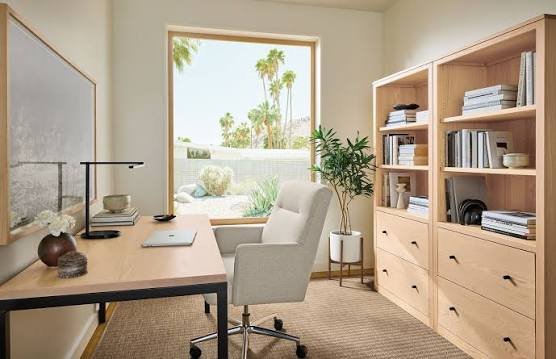
Warm wood finishes are increasingly being paired with contemporary furniture, helping offices feel residential rather than corporate.
3. Make Ergonomics Part of the Design
A modern office should look good from across the room, but it also needs to work comfortably during long sessions.
Start with a supportive chair and a desk height that allows you to work without constantly lifting your shoulders or bending your wrists. Your monitor placement matters too. The U.S. Occupational Safety and Health Administration recommends positioning a monitor directly in front of you, at least 20 inches away, with the top of the screen at or below eye level. It also recommends positioning the screen perpendicular to windows to reduce glare.
This is one area where aesthetics should never take priority over function. A stylish chair that becomes uncomfortable after an hour is a poor office investment.
4. Use Layered Lighting
Lighting can completely change the atmosphere of a workspace.
Instead of relying on one ceiling fixture, combine natural daylight with ambient and task lighting. A desk lamp can illuminate paperwork, while a floor lamp or wall fixture provides softer general light after dark.
If your desk sits beside a window, consider the direction of incoming light throughout the day. The goal is not simply to make the room bright; it is to keep your screen comfortable to view.
Current home-office design guidance increasingly favors layered lighting that can adapt from daytime work to evening use.
5. Keep Storage Simple and Intentional
Clutter can quickly undermine a minimalist office. The solution is not necessarily to remove everything but to give frequently used items a logical home.
Closed cabinets are useful for paperwork, equipment and objects that do not need to remain visible. Open shelving works better for books, a few decorative pieces and items you regularly reach for.
For a small room, use the walls. Tall shelving makes use of vertical space without taking up as much floor area as wide cabinets. Built-in storage can also turn an awkward wall into a feature rather than leaving unused gaps.
Smart storage is a growing design priority, with recent UK home-design research highlighting increasing interest in solutions that keep rooms organized and visually clean.
| Workspace Style | Best Feature | Ideal For |
|---|---|---|
| Floating desk | Saves floor space | Small rooms |
| L-shaped desk | Separates work zones | Multi-taskers |
| Built-in desk | Integrated storage | Dedicated offices |
| Freestanding desk | Flexible placement | Renters |
| Wall-mounted fold-down desk | Disappears when unused | Very compact spaces |
6. Build a Calm Color Palette
Color should support the atmosphere you want rather than simply follow a trend.
Warm whites, beige, soft gray, muted green and natural wood can create a calm background without making the room feel sterile. If you prefer stronger colors, use them selectively on one wall, a chair, artwork or accessories.
A modern office does not have to be monochrome. A restrained palette with one distinctive accent can provide personality without making the workspace visually busy.
For video calls, also consider what appears behind you. A clean wall, shelving arrangement or piece of artwork can create a polished background without looking staged.
💡 Pro Tip: Choose your wall color after deciding on the largest furniture pieces. It is easier to match paint to a desk and chair than to replace expensive furniture because the final color combination feels wrong.
7. Hide the Technology
Modern workspaces often contain more technology than they appear to have. Laptops, monitors, chargers, speakers and power adapters can quickly create visual noise.
Use cable trays underneath the desk, clips along the rear edge and a dedicated charging area for smaller devices. A monitor arm can also free up desk space while creating a cleaner visual line.
For a particularly polished setup, position the power strip where it remains accessible but invisible from normal viewing angles. The aim is not to hide every piece of technology; it is to prevent technology from becoming the dominant feature of the room.
8. Add Warmth With Natural Materials
A purely functional office can feel disconnected from the rest of the house. Natural materials help soften that effect.
Wood desks, woven baskets, linen curtains, wool textiles and greenery can introduce texture without adding unnecessary decoration. Current design inspiration also favors warm timber finishes and matte surfaces for contemporary workspaces.
Plants are particularly useful in offices because they add color and shape without requiring another large piece of furniture. A single tall plant beside the desk can have more visual impact than several small decorative objects scattered around the room.
9. Design for Video Calls Without Making the Room Look Like a Studio
Video meetings have changed the way people think about home-office backgrounds. Your camera area should look intentional, but it should still resemble a real room.
Place the desk so the background has some depth. A bookshelf, artwork, plant or textured wall can create interest without becoming distracting. Keep personal paperwork and clutter outside the camera frame.
If possible, use a separate light source facing you rather than depending entirely on overhead lighting. This creates a more consistent appearance when daylight changes.
10. Make Small Offices Feel Larger
Small rooms do not require oversized furniture to feel professional.
Choose pieces with slim profiles, use vertical storage and avoid filling every wall. A floating desk can visually open the floor, while a large mirror can increase the sense of space. Light-colored walls and consistent finishes can also help the room feel more cohesive.
Some of the strongest modern home office ideas are actually based on doing less. Instead of adding another shelf or accessory, ask whether the room would work better with one fewer object.
Frequently Asked Questions
What makes a home office look modern?
A modern office typically combines clean lines, practical furniture, limited visual clutter and a cohesive material palette. That does not mean everything needs to be white or minimalist. Warm wood, textured fabrics, plants and carefully chosen artwork can create a contemporary space while keeping it comfortable.
What is the best color for a home office?
There is no single best color. Soft neutrals, warm whites, muted greens and earthy shades are popular choices because they create a calm backdrop. If you prefer stronger colors, use one as an accent rather than covering every surface. The room’s natural light should also influence your choice.
How can I create a home office in a small room?
Use a floating or compact desk, vertical shelving and furniture with a slim profile. An alcove or unused corner can become a functional workstation. Keeping the floor visually open is especially helpful, so avoid oversized storage units when wall-mounted alternatives can provide the same capacity.
Should a home office desk face a window?
A window can provide excellent natural light, but direct sunlight on a monitor can create glare. Positioning the screen perpendicular to the window is often more practical. OSHA also recommends considering monitor placement in relation to windows to reduce glare and uncomfortable viewing conditions.
How do I make my office look modern on a budget?
Start with layout, lighting and organization rather than buying a complete furniture set. Declutter the desk, improve cable management, add a quality task light and introduce one or two cohesive decorative elements. Repainting a wall or adding floating shelves can also change the character of a room without a major renovation.
📌 Key Takeaway: The strongest modern home office ideas are based on function first: choose the right layout, make the desk and chair comfortable, control lighting, organize cables and storage, then add materials and decor that make the space feel like home.
Create a Workspace You Will Actually Want to Use
The best office is not necessarily the largest or most expensive one. It is the space that supports your routine without creating unnecessary friction.
Use the available room intelligently, give every important item a purpose and avoid decorating simply to fill empty surfaces. Warm materials, thoughtful lighting and concealed storage can make even a compact workspace feel polished.
Modern home office ideas work particularly well when they combine residential comfort with professional function. Once the practical foundations are right, the style becomes much easier to achieve—and the finished room feels designed rather than assembled.