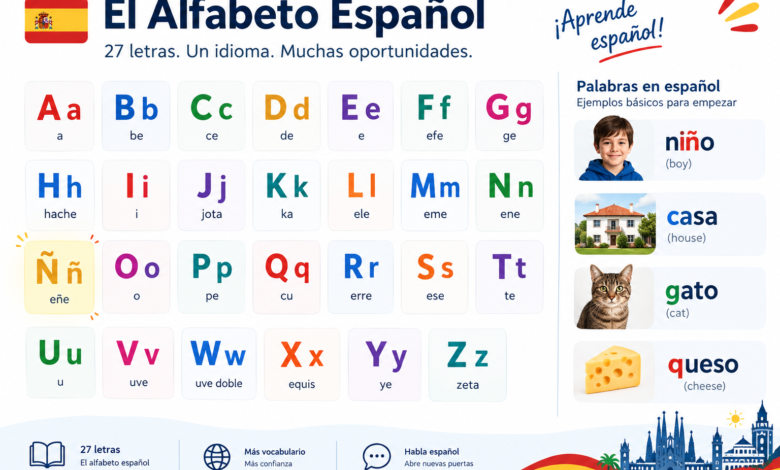
The Spanish alphabet, known as the abecedario or alfabeto español, has 27 official letters. It uses the Latin alphabet familiar to English speakers but adds one distinctive letter: ñ. Spanish letter names and pronunciation patterns can also differ from English.
This guide covers the 27 letters and the sounds that often confuse beginners.


The 27 Letters of the Spanish Alphabet
The 27 letters are:
A, B, C, D, E, F, G, H, I, J, K, L, M, N, Ñ, O, P, Q, R, S, T, U, V, W, X, Y, Z.
FundéuRAE identifies 27 letters. Ch and ll remain common combinations, but they are classified as digraphs rather than separate alphabet letters.
| Letter | Spanish name | Example | Useful note |
|---|---|---|---|
| A | a | amigo | “ah”-like vowel |
| B | be | barco | Close to English b |
| C | ce | casa | Sound varies by context |
| D | de | día | Similar to English d |
| E | e | elefante | Clear “eh” |
| F | efe | familia | Similar to English f |
| G | ge | gato | Changes before e/i |
| H | hache | hola | Normally silent |
| I | i | isla | “ee”-like vowel |
| J | jota | jardín | Strong breathy sound |
| K | ka | kilo | Mostly loanwords |
| L | ele | libro | Clear l sound |
| M | eme | madre | Similar to English m |
| N | ene | noche | Similar to English n |
| Ñ | eñe | niño | Distinct Spanish letter |
| O | o | ocho | Rounded vowel |
| P | pe | papel | Similar to English p |
| Q | cu | queso | Usually appears in qu |
| R | erre | rojo | Sound varies by position |
| S | ese | sol | Usually an s sound |
| T | te | tomate | Similar to English t |
| U | u | uva | “oo”-like vowel |
| V | uve | vaso | Pronounced like b |
| W | uve doble | web | Mainly foreign words |
| X | equis | examen | Several possible sounds |
| Y | ye | yo | Consonant or vowel |
| Z | zeta | zapato | Pronunciation varies by region |
Modern letter names include forms such as ye, uve and uve doble, although older or regional names can still be heard.
Why Ñ Is So Important
For English speakers, ñ is often the most recognizable feature of the alphabet. It is a separate letter, not an n with an accent mark. Its sound is roughly comparable to the “ny” sound in English “canyon.”
Words such as niño, mañana and España show why the distinction matters. Replacing ñ with n can change the spelling and, in some cases, the meaning of a word. The letter is officially part of the 27-letter Spanish alphabet.
Letters That Can Confuse English Speakers
C and G
C can represent different sounds depending on the following vowel and regional pronunciation. In many varieties, casa begins with a k-like sound, while ce and ci are pronounced with an s-like sound in much of Latin America and a th-like sound in much of Spain.
G also changes. Before a, o and u, it commonly has a hard sound, as in gato. Before e or i, it has a stronger breathy sound, as in gente.
H, B and V
Spanish h is normally silent, making hola a useful beginner example.
B and v are different letters in writing, but their pronunciation is much closer than the English b-versus-v contrast. Their exact realization can vary with position in a word.
R
R needs practice because its sound depends on position. A single r and a word-initial r do not always behave the same way, while rr represents a stronger trill in words where that spelling is required.
Are Ch and Ll Letters?
Older materials may list ch and ll as letters, which can make the Spanish alphabet seem inconsistent. They are still used in Spanish, but they are now classified as digraphs: two letters that work together to represent a sound.
Since 2010, the RAE has treated ch and ll as combinations of c+h and l+l rather than independent alphabet entries.
💡 Pro Tip: Practice each letter name aloud and immediately spell a simple Spanish word containing it. This links the written letter, its name, and real vocabulary instead of relying on rote memorization.
Using the Spanish Alphabet in Practice
Start by memorizing all 27 letter names. Then practice the five vowels, which are generally more consistent than English vowels. After that, focus on c, g, h, j, r, v and ñ because these create many beginner questions.
Use short words such as casa, gato, hola, niño, queso, rojo and zapato. Reading them aloud gives you a practical connection between spelling and pronunciation.
Listening is equally useful. Spanish pronunciation varies across countries and regions, so hearing speakers from different parts of the Spanish-speaking world helps you recognize legitimate differences rather than treating one accent as universal.
📌 Key Takeaway: The Spanish alphabet has 27 official letters, including ñ. Ch and ll remain important Spanish digraphs but are not separate alphabet letters. Learning the letter names first, followed by the pronunciation patterns that differ from English, provides a strong foundation for reading and spelling.
Frequently Asked Questions
How many letters are in the Spanish alphabet?
There are 27 official letters in the modern Spanish alphabet, including ñ. Ch and ll are not counted separately because they are digraphs.
Is ñ a separate letter?
Yes. Ñ is an official letter and comes after N in the alphabet. Its sound is distinct from ordinary n.
Are ch and ll still used?
Yes. Both remain part of Spanish spelling. They are classified as digraphs rather than separate alphabet letters.
Why do Spanish letters sound different from English?
Spanish uses many familiar Latin letters, but their names and sounds do not always match English. Regional pronunciation also affects letters such as c, z, g and y.
What is the best way to practice?
Learn the 27 letter names, practice the vowels, then read simple Spanish words aloud. Repetition with real vocabulary is more useful than memorizing an isolated sequence.
Conclusion
Learning the Spanish alphabet becomes much easier once its main differences from English are clear. Its 27 official letters include the distinctive ñ, while ch and ll remain part of Spanish spelling without being separate alphabet entries.
For beginners, the most useful next step is regular practice: learn the letter names, listen to native pronunciation, and spell real Spanish words aloud. That foundation makes reading and pronunciation easier to develop.