
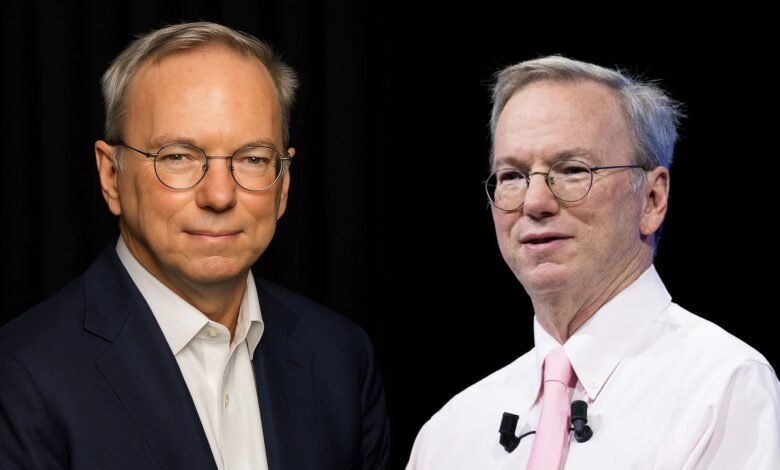
Eric Schmidt is a technology executive, computer scientist, investor and philanthropist best known for helping transform Google from a rapidly growing startup into one of the world’s most influential technology companies. His career, however, extends far beyond Google. He has worked in enterprise software, artificial intelligence, national security policy, scientific research and, more recently, commercial spaceflight.
As of 2026, Schmidt serves as executive chairman and CEO of Relativity Space while remaining active in organizations focused on AI, science and American technological competitiveness.


Who Is Eric Schmidt?
Born on April 27, 1955, Schmidt built his career at the intersection of computer science and business leadership. He earned a bachelor’s degree in electrical engineering from Princeton University before completing a master’s degree and Ph.D. in computer science at the University of California, Berkeley.
Before becoming widely associated with Google, he worked at technology organizations including Bell Laboratories, Xerox PARC, Zilog and Sun Microsystems. At Sun, he spent 14 years and eventually became chief technology officer. He later served as chairman and CEO of enterprise software company Novell.
That combination of engineering knowledge and executive experience made Eric Schmidt an important figure during a period when internet companies were moving from experimental startups to global businesses.
| Area | Key Detail |
|---|---|
| Education | Princeton University; University of California, Berkeley |
| Google leadership | CEO and chairman from 2001 to 2011 |
| Later Alphabet role | Executive chairman and technical adviser |
| Current aerospace role | Executive chairman and CEO of Relativity Space |
| Technology policy | Founder and chair of the Special Competitive Studies Project |
| Philanthropy and science | Associated with Schmidt Sciences, Schmidt Futures and other initiatives |
Eric Schmidt and Google’s Rise
Schmidt joined Google in 2001, when founders Larry Page and Sergey Brin were still developing the company’s business and organizational structure. His arrival gave Google an experienced executive who could help manage rapid growth without abandoning the engineering-driven culture that made the company distinctive.
He served as Google’s chief executive officer and chairman from 2001 to 2011. During that decade, Google expanded its infrastructure and moved into a broader range of products and services while establishing itself as a dominant internet company.
The relationship between Schmidt, Page and Brin became an important part of Google’s early management model. Page and Brin remained deeply involved in product direction and technology, while Schmidt brought experience in corporate operations, management and relationships with investors and other institutions.
After stepping down as CEO, Eric Schmidt continued serving in senior leadership. He remained chairman of Google until 2015, became executive chairman of Alphabet following Google’s corporate restructuring, and later worked as a technical adviser. His advisory role ended in 2020.
Why His Google Years Still Matter
Schmidt’s Google tenure offers a useful example of how leadership can evolve as a startup becomes a mature corporation. Google needed to expand infrastructure, recruit employees, introduce new business lines and compete globally without losing the technical culture that drove its early success.
That period also helped establish Schmidt as a prominent voice on innovation, corporate strategy and the relationship between technology and society.
💡 Pro Tip:
When evaluating Schmidt’s influence, separate his different roles. His Google career concerns corporate growth and technology leadership, while his later work increasingly focuses on AI policy, scientific research, national security and emerging industries.
From Silicon Valley to AI and National Security
Artificial intelligence has become one of the central themes of Eric Schmidt’s post-Google career.
He chaired the U.S. Department of Defense’s Defense Innovation Board beginning in 2016 and later led the National Security Commission on Artificial Intelligence. These roles placed him directly within debates over how AI, computing and emerging technologies could affect national security and international competition.
In 2021, Schmidt launched the Special Competitive Studies Project, a nonprofit organization focused on strengthening America’s long-term competitiveness as AI and other emerging technologies reshape the economy, security and society. He continues to chair the organization.
His public commentary has increasingly examined topics such as advanced AI systems, technological competition with China, energy requirements for computing, biotechnology and the military implications of autonomous technologies. His official site continues to publish and collect his writing and interviews on these subjects.
Aerospace and Relativity Space
One of the biggest recent changes in Schmidt’s career is his move into commercial aerospace. His official biography now identifies him as executive chairman and CEO of Relativity Space, a company developing launch vehicles for the commercial space industry.
The position represents a notable return to direct corporate leadership after years in advisory, investment, policy and philanthropic roles.
Relativity Space also connects with a broader theme in his career: interest in technologies that require large-scale engineering, significant capital and long development timelines.
Science, Philanthropy and Other Initiatives
Schmidt and his wife, Wendy Schmidt, have created or supported several organizations devoted to scientific research and philanthropy.
Their initiatives include the Schmidt Family Foundation, Schmidt Ocean Institute and Schmidt Futures. In 2024, they founded Schmidt Sciences, a nonprofit designed to advance scientific and technological research in fields including artificial intelligence, advanced computing, biosciences, climate and space.
Eric Schmidt also chairs the board of quantum technology company SandboxAQ and remains involved with scientific, academic and policy institutions.
He has also written several books examining technology and management. His recent work includes Genesis: Artificial Intelligence, Hope, and the Human Spirit, published in 2024 with Henry Kissinger and Craig Mundie.
📌 Key Takeaway:
Schmidt’s public profile can no longer be understood solely through his Google years. His current influence spans artificial intelligence, national technology strategy, scientific research, philanthropy and commercial aerospace.
Frequently Asked Questions
What is Eric Schmidt best known for?
He is best known for serving as Google’s CEO and chairman during a crucial period of the company’s expansion. From 2001 to 2011, he worked alongside founders Larry Page and Sergey Brin as Google developed from a Silicon Valley startup into a major global technology company.
What does Eric Schmidt do now?
As of 2026, he is executive chairman and CEO of Relativity Space. He also chairs the Special Competitive Studies Project and remains involved in technology, scientific research, AI policy, philanthropy and several boards and initiatives.
Is Eric Schmidt still connected to Google?
He no longer holds an operating or advisory position at Google or Alphabet. After serving as Google’s CEO, he continued in chairman and executive chairman roles and later became a technical adviser to Alphabet. His technical advisory position ended in 2020.
What did he study?
Schmidt studied electrical engineering at Princeton University and later earned both a master’s degree and a Ph.D. in computer science from the University of California, Berkeley. His technical education preceded a career that moved through engineering, enterprise software, internet technology and executive leadership.
A Career Moving Beyond Google
Eric Schmidt remains closely associated with Google’s extraordinary growth, but his career has expanded considerably since leaving the company’s leadership. His work now crosses some of the most consequential areas of modern technology, from artificial intelligence and scientific discovery to national security and commercial spaceflight.
That breadth explains why he continues to attract attention decades after first becoming a major Silicon Valley executive. Rather than remaining primarily a former Google leader, he has repositioned himself around technologies and institutions likely to influence the next phase of global innovation.







One Comment