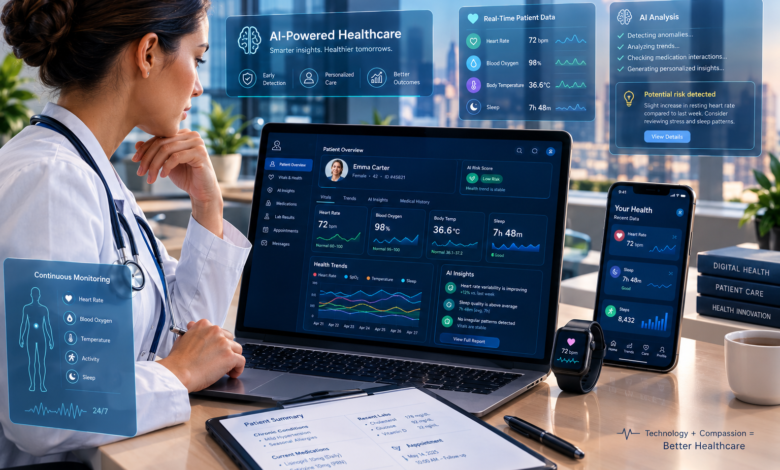
Healthtech news is increasingly focused on technologies that move beyond experimental ideas and into practical healthcare. Artificial intelligence, wearable sensors, remote monitoring, digital clinical trials, and connected medical devices are becoming important parts of how diseases are detected, monitored, and treated.
Recent developments also show that regulation is becoming a bigger part of the story. The U.S. Food and Drug Administration (FDA) says it had authorized more than 1,600 AI-enabled medical devices by September 2026, covering applications ranging from medical imaging to diabetic retinopathy detection and automated insulin dosing.


For readers following healthtech news, the key question is no longer simply what technology can do. It is whether these tools can demonstrate safety, usefulness, reliability, and meaningful outcomes in real healthcare settings.
The Biggest Health Technology Trends Right Now
Several areas are receiving particular attention across the healthcare technology sector.
| Technology area | Current direction | Potential healthcare use |
|---|---|---|
| AI-enabled devices | Expanding into clinical applications | Detection, diagnosis and decision support |
| Wearable sensors | More continuous measurements | Monitoring health and disease indicators |
| Digital health | Greater integration into care | Remote monitoring and patient support |
| AI drug development | More digital data and modeling | Research and clinical development |
| Real-time trials | Testing new data approaches | Faster access to clinical information |
AI remains one of the most visible areas. The FDA describes AI-enabled medical devices as tools that can analyze complex datasets and identify patterns that may support disease detection, diagnosis, treatment, and other healthcare functions.
At the same time, wearable technology is becoming more closely connected with clinical research and healthcare measurement rather than being limited to consumer fitness tracking.
AI Is Moving Deeper Into Medical Devices
One of the clearest themes in current healthtech news is the expansion of artificial intelligence in regulated medical products.
AI can be used to analyze medical images, identify patterns, improve image quality, support diagnostic decisions, and process information that would otherwise require extensive manual review. The FDA’s current database includes authorized AI-enabled devices across multiple medical specialties.
The technology does not remove the need for clinical judgment. Instead, many systems are designed to provide information that can support healthcare professionals.
That distinction matters because medical AI has different requirements from a consumer chatbot. A system used in diagnosis or treatment must be evaluated according to its intended use, risks, performance, and lifecycle.
The FDA says its regulatory approach considers the intended use and technological characteristics of an AI-enabled device, with attention extending from development and validation through deployment, monitoring, maintenance, and modification.
Generative AI Brings New Questions
Generative AI is creating another branch of healthtech news because it can produce text, summaries, recommendations, and other outputs rather than simply classifying existing information.
The FDA issued a discussion paper in August 2026 seeking public feedback on considerations for regulating generative-AI-enabled medical devices. The document addresses areas including risk assessment, premarket evaluation, and postmarket monitoring.
This reflects a practical challenge: generative systems can behave differently from conventional software because their outputs may depend on the information supplied, the model, and how the system is implemented.
Healthcare organizations therefore need to consider accuracy, transparency, validation, privacy, security, and human oversight.
💡 Pro Tip: When evaluating an AI healthcare product, look beyond the word “AI.” Check what the system is actually designed to do, whether it has relevant regulatory authorization, what evidence supports its intended use, and who remains responsible for clinical decisions.
Wearables Are Becoming More Clinically Relevant
Wearables are another major part of healthtech news. Smart rings, watches, patches, sensors, and other connected devices can collect measurements continuously or repeatedly outside traditional clinical environments.
The FDA announced in August 2026 that it had authorized a wearable device capable of continuously monitoring ketone levels and blood sugar.
That development illustrates the direction of digital health: technology can potentially collect information during ordinary daily life rather than only during occasional appointments.
The value of a wearable, however, depends on what is measured, how accurately it is measured, and how the resulting information is interpreted. A consumer wellness metric is not automatically equivalent to a clinically validated measurement.
Digital Health Is Changing Clinical Research
Another important development is the use of digital health technologies in drug development.
The FDA describes digital health technologies as including tools such as actigraphy, photography, and contactless sensors. In 2026, the agency opened a funding opportunity exploring how these technologies could support clinical drug development, including remote data collection and measurement of early manifestations of chronic diseases.
This could change how clinical trials collect information from participants.
Traditional studies often depend heavily on scheduled visits and measurements taken at specific locations. Digital tools can potentially capture information remotely and more frequently, although researchers still need to establish that the measurements are accurate and meaningful.
That makes validation a central issue rather than a secondary technical detail.
Real-Time Clinical Trials Are Getting Attention
Clinical trial infrastructure is also appearing more frequently in healthtech news.
In April 2026, the FDA announced proof-of-concept work involving real-time clinical trials, where certain trial endpoints and data signals could be reported to the agency in real time. The agency also outlined plans for a pilot program.
The underlying idea is straightforward: if reliable information can reach researchers and regulators faster, decisions during clinical development may become more responsive.
That does not mean every trial can instantly become digital or remote. Different diseases, treatments, endpoints, and patient populations require different study designs.
What These Developments Mean for Patients
For patients, health technology can affect several parts of the healthcare experience.
Potential benefits include:
- More continuous health monitoring
- Earlier identification of certain changes
- Greater access to remote care
- More convenient participation in research
- Additional information for healthcare professionals
- New approaches to managing chronic conditions
But technology also introduces questions about privacy, cybersecurity, accessibility, accuracy, and the quality of evidence supporting a product.
A device producing a large amount of data is not automatically more useful than one producing a smaller amount of reliable information.
📌 Key Takeaway: The most significant health technology developments are moving toward practical healthcare applications, but successful adoption depends on evidence, validation, regulation, privacy, and real-world usefulness—not simply technological novelty.
Why Regulation Matters More as Healthtech Expands
Regulation has become an essential part of the conversation because healthcare technology can directly influence medical decisions.
The FDA’s current medical-device updates include work involving AI-enabled devices, sensor-based digital health technology, augmented and virtual reality, and digitally derived measures for clinical investigations.
This creates a different environment from ordinary consumer technology.
A smartphone application can be updated frequently with relatively limited consequences. A medical device may require structured validation, documentation, monitoring, and controls because an error could affect patient care.
For companies developing health technology, regulatory planning therefore needs to be considered alongside engineering and product development.
For consumers, the practical lesson is to distinguish between a wellness product, a medical device, and an AI tool that has a specific regulated healthcare purpose.
What to Watch in Future Healthtech News
The next phase of health technology will likely be shaped by how well these systems perform outside controlled demonstrations.
Watch for developments involving:
- AI-enabled diagnostics and medical imaging
- Continuous wearable monitoring
- Digital measurements used in clinical trials
- Generative AI in regulated medical products
- Remote patient monitoring
- Healthcare cybersecurity and privacy
- Evidence showing whether digital tools improve outcomes
The most useful stories will increasingly be those that explain evidence rather than simply announcing another product launch.
A technology can attract attention because it is technically impressive, but healthcare adoption requires something more: dependable performance in the situations where patients and professionals actually use it.
Frequently Asked Questions
What does healthtech news cover?
Healthtech news covers developments involving technology and healthcare, including artificial intelligence, medical devices, wearables, digital health platforms, telehealth, clinical research technology, health data, and healthcare cybersecurity.
Why is AI important in healthcare technology?
AI can process large datasets and identify patterns that may support disease detection, diagnosis, treatment, and other healthcare tasks. The FDA says AI-enabled medical devices are already being used across a wide range of applications.
Are wearable health devices medical devices?
Not necessarily. Some wearables are designed mainly for wellness or fitness, while others have specific medical purposes and may be subject to regulatory oversight. The intended use and claims associated with a product are important factors.
How can digital health technology help clinical trials?
Digital tools can collect measurements remotely and repeatedly, potentially reducing reliance on traditional in-person data collection. The FDA is exploring technologies such as sensors, photography, and actigraphy for drug-development research.
What should consumers check before using health technology?
Check what the product actually measures, what it is intended to do, how its information should be interpreted, and whether relevant claims are supported by credible evidence. For products involving diagnosis or treatment, professional medical guidance remains important.
Conclusion
The direction of healthtech news is shifting from futuristic concepts toward technologies being tested and used in real healthcare environments. AI-enabled medical devices, wearable sensors, digital clinical-trial tools, and new approaches to remote monitoring are all expanding the role of technology in medicine.
The strongest developments will not simply be the ones with the most advanced technology. They will be the ones that demonstrate reliable performance, appropriate oversight, meaningful patient value, and evidence that supports their intended use.