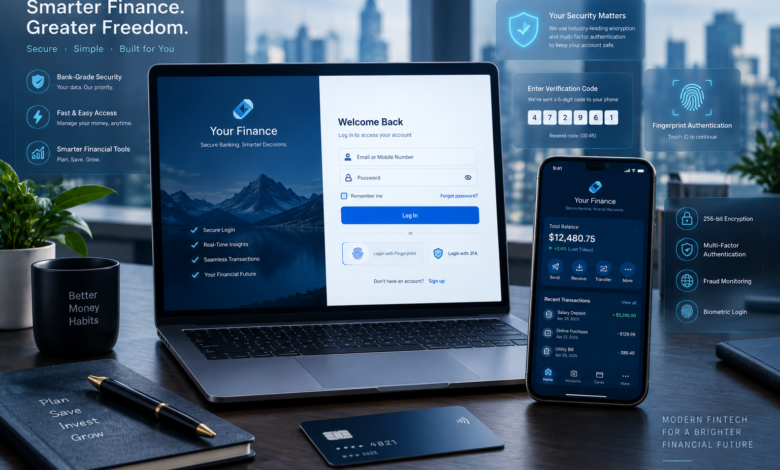
A fintech login is the gateway to a financial technology service, whether you are checking an account, managing payments, reviewing investments, applying for credit, or using a business finance platform. Because these services can handle sensitive financial and personal information, the login process involves more than simply entering a username and password.
Modern fintech platforms may use passwords, one-time codes, biometrics, device verification, or multi-factor authentication to confirm that the person accessing an account is authorized to do so. Understanding these layers can help users recognize legitimate login pages and avoid common security mistakes.


What Is a Fintech Login?
A fintech login is the authentication process used to access a financial technology platform or application. The exact process depends on the service, but a typical sign-in may request an email address, username, password, PIN, or verification code.
Some platforms add another authentication step after the initial credentials. For example, a service may send a temporary code to a registered phone number or require approval through an authenticator application.
This matters because fintech platforms can connect users with bank accounts, payment services, credit products, investment tools, and other financial information. Authentication therefore forms an important part of the platform’s overall security architecture.
How Fintech Login Systems Work
Although individual platforms differ, the basic process usually follows several stages:
- Credential entry: The user provides an identifier and authentication factor.
- Credential verification: The service checks the submitted information against its authentication system.
- Additional verification: The platform may request an OTP, biometric check, device approval, or another factor.
- Session creation: After successful authentication, the user receives an authorized session.
- Monitoring: Security systems may record unusual attempts or detect suspicious activity.
Financial services can also impose limits on failed attempts, terminate inactive sessions, or require additional verification when access appears unusual.
For digital lending applications in Pakistan, for example, the Securities and Exchange Commission of Pakistan’s framework includes login authentication and measures such as multi-factor authentication, strong passwords or biometrics, time-based one-time passwords, failed-attempt controls, and session limits.
Common Authentication Methods
| Authentication Method | How It Works | Main Purpose |
|---|---|---|
| Password | User enters a secret credential | Basic account authentication |
| OTP | Temporary code confirms access | Additional verification |
| MFA | Uses two or more authentication factors | Stronger account protection |
| Biometrics | Face or fingerprint verifies identity | Convenient identity verification |
| Device verification | Recognizes or confirms a trusted device | Helps detect unusual access |
| Passkeys | Uses cryptographic credentials tied to a device | Passwordless authentication |
Not every financial platform supports every method. The available options depend on the provider, application, regulatory environment, and account type.
Why Fintech Login Security Matters
Financial accounts are attractive targets because unauthorized access can expose information or enable transactions. A compromised password may also be dangerous when the same password has been reused across multiple services.
A particularly important issue arises when a fintech application connects to an existing bank account. TD Bank warns that some third-party fintech applications or data aggregators may request banking credentials and potentially access account information. It recommends understanding how a login screen is connected to the financial institution rather than assuming that an unfamiliar screen is an official bank login.
That distinction is useful whenever an application asks for credentials belonging to another financial service.
What makes a login page trustworthy?
Before entering sensitive information, check the website address carefully. Look for the provider’s official domain, a secure connection, and signs that you reached the service through a legitimate source.
Avoid clicking unexpected login links contained in messages. Instead, open the official website or application directly when possible.
💡 Pro Tip: If a financial app suddenly asks you to enter credentials for another institution, stop and verify why those credentials are needed. A familiar-looking login screen does not automatically prove that it belongs to the financial institution shown on the page.
Fintech Login vs. Traditional Banking Login
The two processes can look similar, but they may serve different purposes.
A traditional banking login generally provides access directly to an account operated by the bank. A fintech platform may instead provide payments, budgeting, lending, investment tools, accounting software, or data aggregation.
Some fintech services connect to banks through financial-data infrastructure or APIs, while others may rely on different authentication arrangements. Users should therefore identify which company actually operates the account and which company is requesting access.
For businesses, this distinction can become even more important because fintech platforms may connect several employees, financial systems, payment accounts, and business applications.
What to Do If You Cannot Access Your Account
If a fintech login fails, avoid repeatedly guessing passwords. Many services temporarily restrict access after multiple unsuccessful attempts.
Start by checking:
- Whether the email address or username is correct
- Whether Caps Lock is enabled
- Whether the password was recently changed
- Whether a verification code has expired
- Whether the service requires an updated application
- Whether the provider has reported an outage
Use the platform’s official password-recovery process if necessary. If you receive an unexpected password-reset message, do not automatically follow the link. Open the provider’s official website independently and check the account from there.
Protecting Your Financial Account
Good login security starts with basic account hygiene. Use a unique password for each important financial service and enable multi-factor authentication when the provider offers it.
Keep your phone, computer, browser, and financial applications updated. Security updates can address vulnerabilities that attackers might otherwise exploit.
Also review account alerts. Notifications for new logins, password changes, transfers, or unusual activity can provide an early warning that something is wrong.
📌 Key Takeaway: A secure fintech login combines trustworthy access channels with strong authentication and sensible user behavior. The safest approach is to verify where you are signing in, use unique credentials, enable additional authentication, and investigate unexpected requests for financial information.
Frequently Asked Questions
Is a fintech login safe?
It can be, provided the platform uses appropriate security controls and users access the genuine service. No login system eliminates every risk, so users should also protect credentials and devices.
Why does a fintech app ask for an OTP?
An OTP provides an additional authentication factor. Because the code is temporary, it can make unauthorized access more difficult when someone has obtained a password.
Should I save my financial login in my browser?
A reputable password manager can provide a safer way to manage unique credentials. If you use browser-based password storage, protect the underlying device and account with strong authentication.
What should I do if I suspect unauthorized access?
Use the provider’s official security or account-recovery process immediately. Change compromised credentials, review recent activity, and contact the financial service through its verified support channel.
Can biometrics replace a password?
Some platforms support biometric or passwordless authentication, but the exact implementation varies. Biometrics can provide convenient device-based verification, while the underlying account may still have recovery credentials.
Conclusion
A fintech login is more than a doorway to an app. It is a critical security checkpoint between a user and potentially sensitive financial information.
The best habits are straightforward: access services through verified channels, use unique credentials, enable multi-factor authentication where available, keep devices updated, and question unexpected requests for banking information. Taking those steps can make everyday financial technology safer and easier to use.