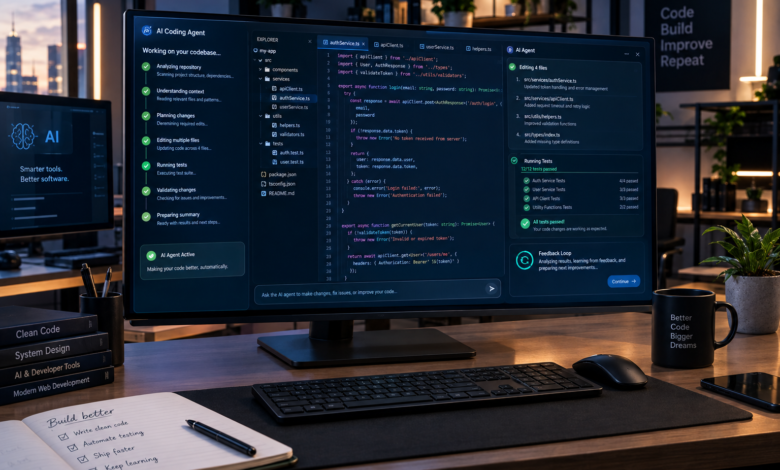
Agentic coding describes a shift from asking AI to suggest code toward giving an AI agent a software goal and allowing it to plan, edit files, run commands, test changes, inspect failures, and iterate. The distinction matters because a coding agent is not simply a faster autocomplete tool. It can work across a repository and use feedback from the development environment to move a task toward completion. Google Cloud describes the approach as AI agents planning, writing, testing, and modifying code with limited human intervention.
For developers, the appeal is practical: routine implementation can be delegated while people spend more time defining requirements, reviewing architecture, checking security, and deciding what should be built.

What Is Agentic Coding?
At its core, agentic coding is a feedback-driven development loop. A developer gives an agent a goal, such as fixing a bug, adding an API endpoint, migrating a component, or creating tests. The agent examines the code, breaks the task into steps, makes changes, executes tools, observes the results, and adjusts its work when something fails.
That ability to act and verify separates agent-based development from ordinary code generation. OpenAI’s current Codex materials describe agents handling features, refactors, migrations, testing, code review, and other engineering work across development environments.
A simple version of the workflow is:
Goal → inspect → plan → edit → run → evaluate → revise → review
The loop can stop when the requested condition is met or when human judgment is required.
How It Differs From Autocomplete and Vibe Coding
AI-assisted development covers several levels of autonomy, and separating them makes the technology easier to understand.
| Approach | Typical AI role | Human role |
|---|---|---|
| Autocomplete | Suggests lines or small blocks | Writes and directs most work |
| Chat-based coding | Explains or generates requested code | Applies, tests, and integrates |
| Vibe coding | Produces larger pieces from natural-language prompts | Guides and checks the result |
| Agentic coding | Plans, edits, executes, tests, and iterates | Sets goals, reviews, and controls boundaries |
The important difference is not simply the amount of code produced. It is the agent’s ability to operate through a multi-step task using tools and feedback. Google Cloud notes that coding agents can navigate files, manage dependencies, run terminal commands, and use errors to improve their work.
Vibe coding can be prompt-driven without requiring an autonomous feedback loop. Agentic development places more emphasis on action, observation, and iteration inside the development environment.
What Can Coding Agents Do?
Modern agents can handle many engineering tasks, although reliability depends on the project, task complexity, tools, and oversight.
Common uses include:
- fixing reproducible bugs
- writing and updating tests
- refactoring existing code
- migrating APIs or frameworks
- generating documentation
- exploring unfamiliar repositories
- implementing features
- reviewing pull requests
- running development commands and interpreting failures
Anthropic’s research on Claude Code found that people generally made more planning decisions while the agent handled more execution decisions. That is a useful model for AI-assisted development: the developer establishes the desired outcome and constraints, while the agent performs more of the mechanical implementation.
💡 Pro Tip: Give an agent explicit acceptance criteria before it starts. “Add authentication” is vague; “add login, preserve existing sessions, test invalid credentials, and do not change the public API” gives it concrete conditions to check.
Where Agentic Coding Helps Most
The strongest use cases tend to have clear inputs, observable outputs, and automated checks.
Bug fixing is a good example. If a failure can be reproduced with a test, an agent can inspect relevant files, attempt a fix, run the test, and iterate. Refactoring can also benefit when a dependable test suite provides a safety net.
Large repositories are another useful setting. An agent can search across files and trace relationships that might otherwise require extensive manual navigation. This does not eliminate the need for engineers who understand the architecture; it can reduce time spent locating and editing the right pieces.
OpenAI also describes multi-agent workflows in which coding agents can work on different tasks or projects in parallel.
Risks and Limits
Autonomy introduces a different kind of engineering risk. An agent can make many correct-looking changes while misunderstanding a requirement, weakening an edge case, or adding an unnecessary dependency.
Security deserves particular attention. Giving an agent access to terminals, repositories, credentials, networks, or deployment systems increases the consequences of mistakes and malicious instructions. OpenAI’s system-card materials describe safeguards including sandboxing and configurable network access for coding-agent environments.
Other concerns include:
- incorrect assumptions about business logic
- changes that pass narrow tests but break broader behavior
- excessive automated edits
- dependency and licensing issues
- prompt injection through untrusted repository content
- difficulty reviewing very large diffs
The practical answer is not removing humans from the process. Good workflows keep people involved at requirements, permissions, architecture, security-sensitive actions, code review, and deployment.
A Practical Workflow
Start by defining the task and acceptance criteria. Give the agent only the repository access and tools it needs. Ask it to inspect relevant code before changing anything. For complex work, review the plan first.
Then let it implement in manageable stages. Run tests after meaningful changes rather than waiting until the end. Review the final diff for correctness, security, maintainability, error handling, and unintended edits.
Agentic coding works best when verification is built into the workflow rather than treated as an optional final step.
📌 Key Takeaway: Agentic coding is AI-driven software execution with a feedback loop, not simply AI-generated source code. Its value comes from combining reasoning, tool use, iteration, and verification while humans remain responsible for goals and important decisions.
Frequently Asked Questions
Is agentic coding the same as AI coding assistance?
No. Traditional AI assistance may suggest code or answer questions. An agent can take a goal, use development tools, make changes, run commands, observe results, and continue through multiple steps.
Does it replace software developers?
It can automate parts of implementation, but human judgment remains important for requirements, architecture, security, testing strategy, review, and product decisions.
What tools are used for agentic coding?
Tools vary, but modern coding agents can work through terminals, IDEs, repositories, version control, test runners, and connected development systems. Examples include OpenAI Codex and Anthropic’s Claude Code.
Is agentic coding safe?
It can be used with appropriate controls, but autonomy increases the importance of permissions, sandboxing, secrets management, testing, review, and network restrictions. High-impact actions should have appropriate human controls.
What skills remain important for developers?
Software design, debugging, testing, security, architecture, requirements analysis, and business understanding remain valuable. As agents handle more implementation, the ability to specify and evaluate software becomes increasingly important.
Conclusion
Agentic coding changes the unit of AI assistance from a line of code to a software task. A capable agent can inspect a project, make changes, run checks, learn from failures, and revise its work. The results still depend on clear requirements, reliable verification, sensible permissions, and human review. For teams adopting the technology, the practical goal is useful autonomy with clear boundaries.