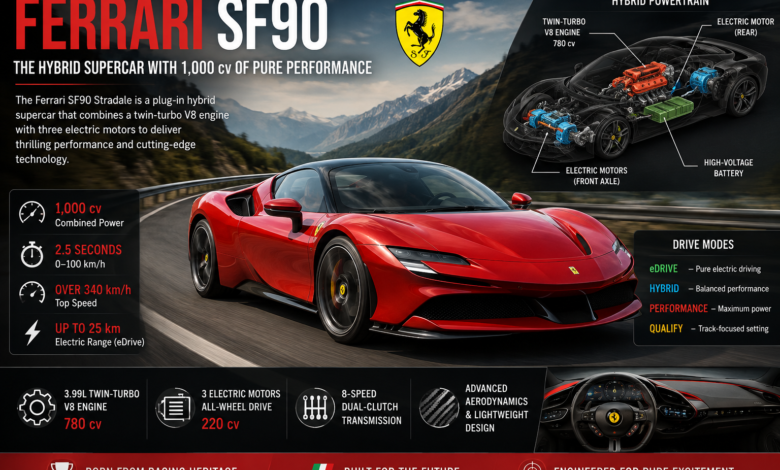
The Ferrari SF90 is one of the clearest examples of how Ferrari blended traditional supercar engineering with plug-in hybrid technology. The name is most closely associated with the SF90 Stradale, a mid-engine V8 hybrid that combines a twin-turbocharged petrol engine with three electric motors. Ferrari developed it as a road car with extreme performance, all-wheel drive, and a limited ability to travel using electric power alone.
Unlike a conventional hybrid designed mainly around efficiency, the SF90 uses electrification as a performance tool. Its combined output reaches 1,000 cv, while Ferrari lists a 0–100 km/h time of 2.5 seconds and a top speed above 340 km/h. It can also travel up to 25 km in electric mode under the conditions specified by Ferrari.


What Is the Ferrari SF90?
The Ferrari SF90 Stradale is a mid-engine plug-in hybrid supercar introduced as a major technological step for Ferrari’s road-car range. Its name pays tribute to Ferrari’s racing heritage and the 90th anniversary of the Scuderia Ferrari racing team.
At the heart of the car is a 3,990 cc, 90-degree V8 twin-turbocharged engine. The combustion engine produces 780 cv on its own, while three electric motors provide additional power. Two electric motors operate at the front, and another works with the rear drivetrain. Together, the system produces the car’s 1,000-cv combined output.
This arrangement also gives the car all-wheel drive. Rather than simply adding an electric motor for lower fuel consumption, Ferrari used the hybrid system to improve acceleration, traction, and overall control.
Ferrari SF90 Performance and Powertrain
The powertrain is the defining feature of the Ferrari SF90. Its petrol engine is paired with an electric system and an eight-speed dual-clutch transmission. The front electric motors make four-wheel drive possible, while the rear drivetrain combines the V8 with another electric motor.
Ferrari quotes a 0–100 km/h acceleration time of 2.5 seconds for the SF90 Stradale. Its maximum speed exceeds 340 km/h, placing it firmly among the most performance-focused road cars produced by the marque.
The electric system also changes how the car delivers power. At lower speeds, electric assistance can provide immediate response, while the V8 supplies sustained performance as speeds rise. Ferrari’s engineering approach makes the two systems work as a single performance package rather than treating the electric powertrain as a separate feature.
Key Specifications
| Specification | Ferrari SF90 Stradale |
|---|---|
| Engine | 3.99-liter twin-turbo V8 |
| Engine output | 780 cv |
| Combined power | 1,000 cv |
| Electric motors | 3 |
| Drive system | All-wheel drive |
| Transmission | 8-speed dual-clutch |
| 0–100 km/h | 2.5 seconds |
| Top speed | Over 340 km/h |
| Electric range | Up to 25 km |
Ferrari’s published technical information gives these figures for the SF90 Stradale and describes the electric system as capable of pure-electric driving.
Electric Driving and Hybrid Technology
One of the most unusual aspects of the Ferrari SF90 is its ability to operate without the V8 running. Ferrari’s eDrive mode allows the car to travel using electric power alone, with a maximum electric range of up to 25 km under its stated conditions.
That capability gives the car a different character in urban environments. A driver can use electric propulsion for short journeys or low-speed situations and switch to the full hybrid system when stronger performance is required.
The front electric motors also have an important role in traction. Ferrari designed the system so that the front axle can provide electric assistance when appropriate. According to Ferrari, the front axle disconnects above 210 km/h, leaving rear-wheel drive at those higher speeds.
Ferrari SF90 Design and Aerodynamics
The exterior design is more than a visual statement. Ferrari developed the body around aerodynamic efficiency, downforce, cooling, and high-speed stability.
The car has a low, mid-engine profile with a cabin positioned toward the front of the overall body. Ferrari describes the design as an evolution toward a more futuristic visual identity, while the aerodynamic development was intended to provide substantial aerodynamic load without creating unnecessary drag.
The proportions also reflect the technical layout. The V8 sits behind the occupants, while the electric hardware and battery system are integrated into the overall vehicle architecture. This makes the SF90 visually recognizable as a modern Ferrari while distinguishing it from earlier naturally aspirated and conventional turbocharged models.
Interior and Driver Technology
Inside, Ferrari took a different approach from the traditional analog cockpit. The SF90 features a heavily digital driver interface, including a large curved display and a head-up display. Ferrari also redesigned the steering wheel around digital controls and driving-mode selection.
The steering wheel includes the Manettino system and controls for the car’s different powertrain settings. Among the available modes is the electric-focused ED setting, allowing the driver to prioritize electric propulsion.
This technology is not simply there to make the cabin look modern. The driver can use it to manage the relationship between the combustion engine, electric motors, battery energy, and performance settings.
💡 Pro Tip: When comparing the SF90 with other hybrid supercars, look beyond the combined horsepower figure. The placement of the electric motors, all-wheel-drive strategy, transmission, battery behavior, and driving modes explain much more about how the car actually delivers its performance.
SF90 Stradale vs. SF90 Spider
The Ferrari SF90 family also includes the SF90 Spider, a convertible version that retains the core hybrid performance concept while adding a retractable hard top. Ferrari describes the Spider as its first plug-in hybrid spider.
The Spider uses the same basic 3,990 cc twin-turbo V8 architecture and three-motor hybrid layout. Ferrari lists 1,000 cv of combined power, a 0–100 km/h time of 2.5 seconds, a 340 km/h maximum speed, and an electric range of up to 25 km.
The major distinction is the open-top driving experience. Buyers choosing between the two versions therefore have to decide whether the added appeal of a retractable hard top outweighs the priorities of a fixed-roof supercar.
Why the SF90 Matters
The importance of the Ferrari SF90 goes beyond its acceleration figures. It demonstrated that Ferrari could use plug-in hybrid technology without moving away from the high-performance character associated with its road cars.
The project also brought together several technologies that had previously been less common in Ferrari road cars: a plug-in hybrid system, multiple electric motors, electric front-wheel drive, digital cockpit controls, and advanced electronic chassis management.
That combination makes the SF90 an important bridge between Ferrari’s traditional combustion-engine supercars and the increasingly electrified performance cars appearing across the industry.
📌 Key Takeaway: The Ferrari SF90 is not simply a powerful Ferrari with an electric motor added to it. Its 3.99-liter twin-turbo V8, three electric motors, all-wheel-drive system, and 1,000-cv combined output were engineered as one integrated performance package. Its ability to drive electrically for short distances adds another layer to a car designed primarily around speed and control.
Frequently Asked Questions
Is the Ferrari SF90 fully electric?
No. The SF90 is a plug-in hybrid rather than a fully electric vehicle. It combines a twin-turbocharged V8 gasoline engine with three electric motors. Ferrari also provides an electric driving mode that allows the car to operate without the combustion engine for a limited distance.
How much horsepower does the Ferrari SF90 have?
The SF90 Stradale has a combined output of 1,000 cv. Its twin-turbo V8 contributes 780 cv, with the electric motors supplying the remaining power. Ferrari developed this combination to improve both straight-line acceleration and traction.
How fast is the Ferrari SF90?
Ferrari lists a 0–100 km/h acceleration time of 2.5 seconds for the SF90 Stradale and a maximum speed above 340 km/h. Those figures place it firmly in the high-performance supercar category.
Does the Ferrari SF90 have all-wheel drive?
Yes. The SF90 uses electric motors on the front axle alongside its rear powertrain, giving it all-wheel drive. Ferrari’s system is designed to provide additional traction and performance rather than functioning like a conventional mechanical four-wheel-drive setup.
What is the difference between the SF90 Stradale and SF90 Spider?
The Stradale is the fixed-roof version, while the Spider adds a retractable hard top. Both use the same fundamental plug-in hybrid concept and Ferrari lists the Spider with 1,000 cv, a 2.5-second 0–100 km/h time, and a 340 km/h top speed.
Conclusion
The Ferrari SF90 represents a significant change in the way Ferrari approaches supercar performance. Instead of treating electrification as a compromise, Ferrari integrated electric motors with a twin-turbo V8 to create a 1,000-cv all-wheel-drive powertrain.
Its combination of acceleration, electric driving capability, digital technology, aerodynamic development, and unmistakable Ferrari design gives the SF90 a distinctive place in the modern supercar landscape. For anyone researching the Ferrari SF90, its most interesting feature is not a single specification but the way its combustion and electric systems work together.