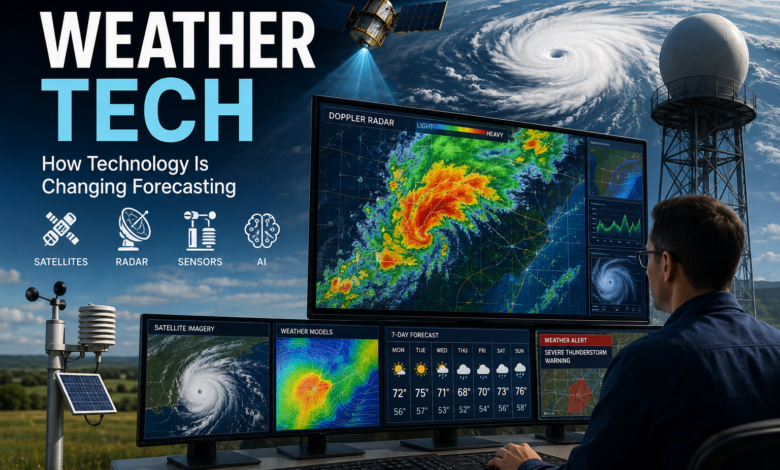
Weather tech has changed the way people understand storms, rainfall, temperature, wind, and other atmospheric conditions. What once depended heavily on observations from a limited number of locations can now draw on satellites, radar networks, sensors, aircraft, computer models, and artificial intelligence.
For people checking a forecast before traveling, farming, flying, running a business, or preparing for severe weather, these tools provide far more information than a simple temperature reading. Modern forecasting combines enormous amounts of data with increasingly powerful computing to produce more detailed predictions.


What Is Weather Tech?
Weather tech refers to the technologies used to observe, measure, analyze, predict, and communicate atmospheric conditions. It covers both hardware and software, ranging from weather stations and Doppler radar to satellites, forecasting models, mobile applications, and AI-based systems.
The National Weather Service, for example, provides radar products that display precipitation and other information on interactive maps alongside forecasts and alerts.
The field is broad because weather itself is complex. Temperature sensors may measure conditions near the ground, while satellites observe large atmospheric systems from space. Radar can track precipitation, and computer models process observations to estimate how conditions may develop.
How Modern Weather Technology Works
The strongest forecasting systems do not depend on one device. They combine information from multiple sources and continuously update their understanding of the atmosphere.
Satellites Watch Weather From Space
Weather satellites provide a wide view of clouds, storms, moisture, and atmospheric patterns. Their observations are particularly valuable over oceans and remote areas where conventional ground-based measurements are limited.
Satellite imagery can help forecasters monitor developing storm systems, identify cloud movement, and understand large-scale weather patterns. This information becomes especially useful when combined with radar and surface observations.
Radar Tracks Rain and Storms
Radar is one of the most recognizable forms of weather tech. Doppler radar can help meteorologists detect precipitation and analyze its movement and characteristics.
In the United States, the National Weather Service radar system provides mapped radar information that can be used with forecasts and alerts.
Radar is particularly useful for short-term decisions. A forecast may say thunderstorms are possible later in the day, while radar can show where precipitation is already developing and how it is moving.
Sensors Create Local Weather Data
Weather stations and connected sensors measure conditions such as temperature, pressure, humidity, wind speed, and rainfall. Networks of these instruments provide localized information that broad satellite observations cannot always capture.
Smart sensors can also send measurements automatically to centralized systems. This creates a continuous flow of observations that can support forecasting, agriculture, transportation, construction, and emergency planning.
The Growing Role of AI and Computer Models
Artificial intelligence is becoming an increasingly important part of weather analysis. Traditional numerical weather prediction uses mathematical equations and massive computing resources to simulate atmospheric behavior. AI can complement these approaches by identifying patterns in large datasets and accelerating certain forecasting tasks.
The biggest advantage is not simply producing a forecast faster. Better computing can help systems analyze more observations and generate predictions at greater geographic and temporal detail.
That matters because weather decisions often depend on local conditions. A difference of a few miles can affect whether a storm passes directly over a community or misses it.
| Technology | Main Purpose | Where It Helps Most |
|---|---|---|
| Satellites | Observe large atmospheric systems | Storm tracking and regional patterns |
| Doppler radar | Monitor precipitation and movement | Short-term storm forecasting |
| Weather stations | Measure local conditions | Temperature, wind, rainfall and pressure |
| Computer models | Simulate future atmospheric conditions | Medium- and long-range forecasting |
| AI systems | Analyze patterns and large datasets | Faster and more detailed prediction |
Why Weather Tech Matters in Everyday Life
The value of weather tech extends far beyond checking an app before leaving home. Reliable forecasts influence decisions across many industries.
Airlines use atmospheric information for flight planning and safety. Farmers monitor rainfall, temperature, frost, and severe weather risks when managing crops. Energy companies use forecasts to anticipate changes in demand and renewable power generation.
Emergency services also depend on timely warnings. Severe thunderstorms, hurricanes, flooding, winter storms, and other hazards can require communities to make decisions before conditions become dangerous.
For ordinary households, the benefits are simpler but still significant. Better forecasting can help people decide when to travel, protect outdoor equipment, prepare for heavy rain, or change plans around extreme conditions.
💡 Pro Tip: Don’t rely on a single weather indicator during rapidly changing conditions. Check the local forecast alongside current radar and official alerts. Radar shows what is happening now, while forecasts describe what meteorologists and models expect next.
The Limits of Weather Technology
Even advanced weather tech cannot eliminate uncertainty. The atmosphere is a highly dynamic system, and small changes in initial conditions can influence what happens later.
Forecast accuracy also depends on location and timescale. Conditions several hours ahead are generally easier to monitor than atmospheric behavior many days into the future. Local terrain, coastlines, urban areas, and rapidly developing storms can create additional complications.
Technology also produces large quantities of data, but data alone does not guarantee a perfect prediction. Meteorologists still play an important role in interpreting observations, evaluating model output, and communicating risks.
This is why a responsible forecast should be viewed as useful guidance rather than an absolute promise about future conditions.
What Comes Next for Weather Technology?
The next generation of weather tech is likely to focus on greater resolution, faster processing, improved observation networks, and more useful local predictions.
AI-assisted forecasting may make it easier to process huge volumes of atmospheric information. More connected sensors could also increase the amount of real-time data available from cities, farms, roads, and other environments.
Another important direction is clearer communication. A technically accurate forecast is not enough if people cannot understand what it means for them. Future systems will need to turn complex atmospheric information into practical warnings and location-specific guidance without creating unnecessary confusion.
📌 Key Takeaway: The real strength of weather tech comes from combining different technologies rather than depending on one tool. Satellites provide broad coverage, radar tracks developing precipitation, sensors capture local conditions, and forecasting models turn observations into predictions. Together, these systems give people a much clearer picture of changing weather.
Frequently Asked Questions
What is weather tech used for?
Weather tech is used to observe atmospheric conditions, analyze weather data, create forecasts, track storms, and communicate warnings. It supports everyday activities as well as aviation, agriculture, transportation, emergency management, energy planning, and scientific research.
How does radar improve weather forecasting?
Radar provides detailed information about precipitation and its movement. This makes it particularly valuable for short-term forecasting because meteorologists can monitor developing rain or thunderstorms and assess how those systems are moving.
Can AI predict the weather better than traditional models?
AI can improve certain forecasting tasks and process information efficiently, but it does not simply replace traditional forecasting systems. Modern approaches can combine AI techniques with observations, numerical models, and meteorological expertise to produce useful predictions.
Why are weather forecasts sometimes wrong?
Forecasts can be uncertain because atmospheric conditions constantly change and small differences in starting conditions can affect later outcomes. Local geography and rapidly developing storms can also make predictions more difficult, especially over longer time periods.
What technology tracks hurricanes?
Hurricanes are monitored using several technologies, including satellites, radar, aircraft observations, ocean measurements, surface stations, and computer forecasting models. Combining these sources helps meteorologists track a storm’s position, structure, movement, and potential impacts.
The Future Looks More Connected
From satellites orbiting Earth to sensors measuring conditions on the ground, weather tech has transformed forecasting into a highly connected process. Its greatest benefit is the ability to combine observations from different sources and turn them into information people can use.
As computing, AI, sensors, and forecasting models continue to improve, weather predictions should become more detailed and useful at local levels. The technology will not remove uncertainty from the atmosphere, but it can give communities, businesses, and individuals better information for making decisions when weather matters most.