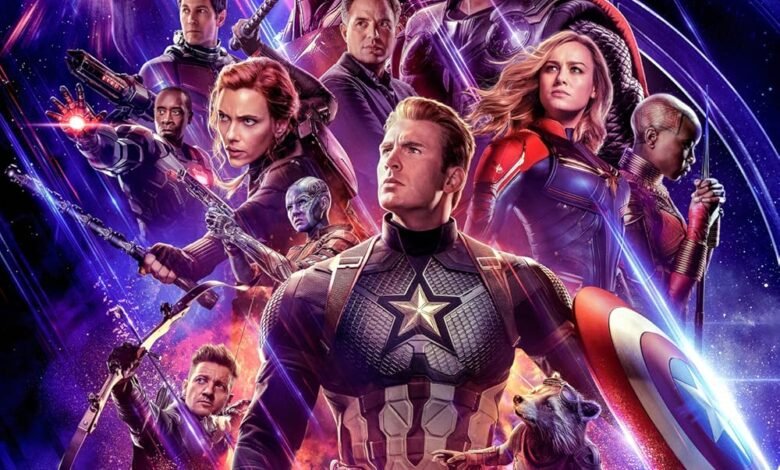
Released on April 26, 2019, Avengers Endgame became one of the defining blockbuster movies of its generation. Directed by Anthony and Joe Russo, the Marvel Studios production brought together characters and storylines developed across the first 22 films of the Marvel Cinematic Universe. Marvel describes the movie as the conclusion to that initial 22-film journey.
The film begins after the devastating events of Avengers: Infinity War, leaving the surviving heroes facing an impossible situation. Rather than relying only on spectacle, the story focuses heavily on loss, responsibility, friendship and the consequences of earlier decisions.


That combination helped Avengers Endgame appeal to both longtime MCU followers and casual moviegoers who wanted to see how the enormous storyline would end.
What Is Avengers Endgame About?
The story follows the surviving Avengers as they attempt to reverse the destruction caused by Thanos. Half of all life in the universe has disappeared, and the remaining heroes are struggling with the consequences.
Tony Stark, Steve Rogers, Thor, Natasha Romanoff, Clint Barton, Bruce Banner and the other surviving characters approach the crisis from very different emotional positions. Some want immediate action, while others are dealing with grief or trying to rebuild their lives.
Without revealing every major twist, the movie eventually develops into a large-scale mission involving time, memory and the consequences of changing the past.
What makes the narrative unusual for a superhero blockbuster is its willingness to slow down. The movie gives individual characters room to reflect before returning to its enormous action sequences.
The Main Cast and Characters
Avengers Endgame features an unusually large ensemble cast because it serves as a meeting point for numerous MCU storylines.
Robert Downey Jr. plays Tony Stark/Iron Man, while Chris Evans returns as Steve Rogers/Captain America. Chris Hemsworth portrays Thor, Mark Ruffalo plays Bruce Banner/Hulk, Scarlett Johansson appears as Natasha Romanoff/Black Widow, and Jeremy Renner returns as Clint Barton/Hawkeye.
The cast also includes Brie Larson as Captain Marvel, Don Cheadle as James Rhodes/War Machine, Paul Rudd as Scott Lang/Ant-Man, Karen Gillan as Nebula and Danai Gurira as Okoye. Marvel’s official material highlights several of these performers while discussing the emotional significance of completing the MCU’s first major saga.
| Element | Details |
|---|---|
| Release date | April 26, 2019 |
| Directors | Anthony Russo and Joe Russo |
| Producer | Kevin Feige |
| Screenplay | Christopher Markus and Stephen McFeely |
| Studio | Marvel Studios |
| MCU position | 22nd film in the original MCU sequence |
| Main conflict | Avengers vs. the consequences of Thanos’ actions |
Why the Character Arcs Matter
One reason Avengers Endgame remains memorable is that the central conflict is not simply about defeating a villain.
Tony Stark’s journey is tied to responsibility and sacrifice. Steve Rogers’ storyline explores duty and the personal life he repeatedly places behind his obligations. Thor’s arc takes a different direction, showing a hero struggling with failure and self-worth.
Natasha Romanoff and Clint Barton provide another emotional dimension. Their friendship becomes especially important as the characters confront what must be sacrificed to achieve their objective.
These individual stories make the final battle more meaningful. The spectacle works because viewers understand what the characters have already lost and what they are willing to risk.
💡 Pro Tip: If you are watching Avengers Endgame for the first time, avoid reading detailed plot summaries beforehand. The movie depends heavily on character reveals and emotional payoffs, so going in with minimal spoilers makes the experience considerably stronger.
The Scale of Its Box Office Success
The commercial performance of Avengers Endgame was extraordinary. Disney reported an estimated $1.209 billion global opening weekend, making it the first movie to cross $1 billion during its opening weekend. The film reached that milestone in only five days.
Its performance continued to grow. Disney reported that the movie passed $2 billion globally in just 11 days, faster than any film had previously reached that figure.
By July 2019, Disney announced that the film had overtaken Avatar to become the highest-grossing global release at that time.
Those numbers demonstrate more than commercial success. They show how effectively Marvel transformed years of interconnected storytelling into a worldwide cinematic event.
Visual Effects and Technical Achievement
The film’s scale required extensive visual-effects work. Major battles, digital characters, environments and large-scale destruction were combined with traditional production techniques to create its futuristic superhero world.
That work received formal recognition when Avengers Endgame was nominated for the Academy Award for Visual Effects at the 92nd Oscars. The nominated team included Dan DeLeeuw, Russell Earl, Matt Aitken and Dan Sudick.
Although the movie did not win that category, the nomination reflected the technical ambition behind its biggest sequences.
Why Avengers Endgame Still Has a Strong Fan Following
The film’s lasting popularity comes partly from its emotional connection to earlier MCU movies. A viewer who has followed the characters for years experiences the ending differently from someone seeing the characters for the first time.
The movie also became a cultural event because audiences had spent more than a decade watching relationships develop across interconnected films. Marvel itself described the production as the culmination of the first 22 movies and emphasized the connection between the filmmakers, cast and fans.
Another reason Avengers Endgame remains frequently discussed is its balance of humor and serious drama. The film can move from a quiet character moment to an enormous action sequence without abandoning its central emotional themes.
📌 Key Takeaway: Avengers Endgame succeeded because it treated its massive superhero conflict as a character story. Its record-setting box office mattered, but the film’s lasting impact comes from the relationships, sacrifices and long-running storylines that led to its final chapter.
Frequently Asked Questions
Is Avengers Endgame the last Marvel movie?
No. It is not the final Marvel movie overall. Instead, it serves as the conclusion to the first major MCU saga built across 22 films. Marvel’s official page identifies it as the culmination of that initial sequence, while later MCU projects continued the franchise.
When was Avengers Endgame released?
The movie was released on April 26, 2019. Marvel Studios lists Anthony and Joe Russo as directors, Kevin Feige as producer, and Christopher Markus and Stephen McFeely as the screenplay writers.
How successful was Avengers Endgame?
It became one of the most commercially successful films ever released. Disney reported a $1.209 billion global opening weekend and said the movie crossed $2 billion globally in only 11 days.
Does Avengers Endgame have a post-credit scene?
Unlike many MCU films, Avengers Endgame does not use a traditional post-credit scene to introduce the next movie. Its ending is designed primarily as an emotional conclusion to the story that came before it.
Did Avengers Endgame win an Oscar?
The movie received an Academy Award nomination for Visual Effects at the 92nd Oscars, but it did not win. 1917 won the category.
Conclusion
Avengers Endgame remains an important milestone in modern franchise filmmaking because few movies had attempted to connect so many characters and stories before reaching one enormous conclusion.
Its box office records attracted global attention, but the film’s real strength is the emotional investment built over years of MCU storytelling. From its characters and performances to its visual effects and final battle, Avengers Endgame gave audiences a payoff designed around both spectacle and personal sacrifice.
For viewers revisiting the MCU, it remains a film best understood not as an isolated superhero adventure, but as the culmination of an interconnected cinematic journey.