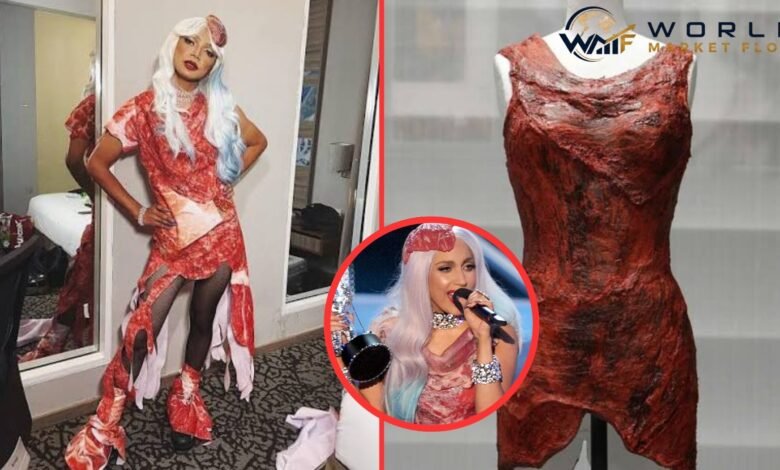
Few cultural moments in modern pop history altered red-carpet fashion quite like the 2010 MTV Video Music Awards. When Lady Gaga stepped out in a outfit made entirely of raw flank steak, the world stood still. Some saw it as a cheap bid for shock value, while others recognized it as a sharp piece of performance art.
The raw beef garment was not just a viral stunt—it was a engineered political statement, a structural design challenge, and an archival puzzle. To understand why this moment remains so relevant today, we need to look beyond the initial media frenzy and evaluate the craftsmanship, the actual socio-political message, and what happened to the dress after the cameras stopped flashing.


The Origin of the Meat Dress: Conception and Craftsmanship
The story of the dress began long before the 2010 VMAs red carpet. Working alongside legendary stylist Nicola Formichetti, designer Franc Fernandez was tasked with creating something completely unprecedented for Gaga’s final look of the night.
[2010 MTV Video Music Awards]
        │
        ├── Initial Red Carpet Look: Alexander McQueen Archive
        ├── Main Show Change: Giorgio Armani Privé
        └── Final Award Acceptance: Raw Flank Steak Dress by Franc Fernandez
The Materials and Construction
Creating a wearable garment out of raw animal flesh presented technical difficulties that traditional haute couture never faces:
- The Material: Fernandez sourced approximately 35 to 40 pounds of raw flank steak from his family’s local butcher shop, Palermo Deli in Granada Hills, California. Flank steak was selected specifically because it is a lean cut with minimal fat, meaning it would not drip grease or deteriorate rapidly under warm studio lighting.
- The Assembly: There were no preliminary fittings. The dress was hand-cut, sculpted, and hand-sewn directly onto an underlying corset base in Gaga’s backstage dressing room just minutes before she took the stage.
- Accessories: The look was complete with matching steak-wrapped heels (secured with butcher’s twine), a meat clutch purse, and a small steak fascinator pinned into her hair.
What Did Lady Gaga’s Meat Dress Actually Mean?
While critics initially dismissed the outfit as a desperate bid for headlines, the dress carried a clear, multi-layered message.
The Political Statement Against “Don’t Ask, Don’t Tell”
The primary motivation behind the outfit was political activism. Appearing on The Ellen DeGeneres Show shortly after the awards, Gaga explained the core allegory:
“If we don’t stand up for what we believe in and if we don’t fight for our rights, pretty soon we’re going to have as much rights as the meat on our own bones.”
Gaga wore the garment alongside former U.S. military service members who had been discharged or impacted under the U.S. military’s “Don’t Ask, Don’t Tell” policy. The dress served as a visual metaphor warning against the dehumanization of citizens and service personnel—reducing human beings to mere “pieces of meat” without rights or dignity.
Dehumanization in the Entertainment Industry
On a secondary level, the look served as a critique of celebrity culture and tabloid media. It highlighted how the public and media consume pop stars, treating human performers as consumable commodities to be picked apart, scrutinized, and discarded.
Behind the Scenes: Real-World Logistics & Practical Realities
Media coverage often glosses over the physical realities of wearing 35 pounds of raw beef on live television.
┌──────────────────────────────────────────────────────────┐
│                   BEHIND THE SEAMS                       │
├─────────────────────────┬────────────────────────────────┤
│ Total Meat Weight       │ ~35-40 lbs of Flank Steak      │
├─────────────────────────┼────────────────────────────────┤
│ Material Cost           │ ~$3.99 per pound ($140 total)  │
├─────────────────────────┼────────────────────────────────┤
│ Assembly Time           │ Backstage minutes before entry │
├─────────────────────────┼────────────────────────────────┤
│ Structural Support      │ Built-in underlying corset     │
└─────────────────────────┴────────────────────────────────┘
- Weight Distribution: Carrying 35 pounds of wet material requires serious physical stamina. The underlying corset bore most of the load, preventing the meat from tearing away from the stitching under its own weight.
- Smell and Temperature Control: Because the meat was kept cold on ice up until assembly, it did not emit a foul decay odor during the broadcast. According to Fernandez and Gaga herself, the outfit simply smelled like fresh raw beef.
- Tactile Comfort: Cher, who presented Gaga with the Video of the Year award for “Bad Romance,” later noted that holding Gaga’s meat purse backstage felt surprisingly natural, though cold and damp.
Preservation Science: How the Dress Became Beef Jerky
How do you preserve a perishable piece of biological tissue for permanent museum display? You hire a professional taxidermist.
After the ceremony, the outfit was placed into deep freeze storage. The Rock and Roll Hall of Fame subsequently commissioned Burbank taxidermist Sergio Vigilato for $6,000 to permanently preserve the garment.
[Raw Beef State] ──► [Deep Freeze] ──► [Chemical Sanitization] ──► [Curing/Desiccation] ──► [Color Restoration] ──► [Museum Display]
The Preservation Process
- Decontamination: The dress was thawed and treated with a mix of bleach, formaldehyde, and specialized detergents to kill off any emerging bacteria or mold spores.
- Desiccation (Curing): The meat underwent a multi-week chemical dehydration process, essentially transforming the raw beef flank into a stiff, preserved beef jerky.
- Structural Reconstruction: As the meat dried, it shrank, lost its flexibility, and darkened significantly. Vigilato re-sculpted the dried slabs over a custom fiberglass mannequin matching Gaga’s exact measurements.
- Color Restoration: Because natural drying turns meat a dark brown, conservators had to paint and dye the preserved leather-like material back to a rich, dark crimson hue to match its original appearance on the red carpet.
The preserved dress went on display at the Rock and Roll Hall of Fame in Cleveland before being moved to the Haus of Gaga museum exhibition at Park MGM in Las Vegas, where it remains archived.
3 Industry Insights Missing From Most Retrospectives
1. The Tactical Choice of Flank Steak
Most general media outlets refer to the outfit simply as a “steak dress.” However, the specific choice of flank steak was a deliberate structural decision. Flank steak features long, continuous muscle fibers with low intramuscular fat. Had the designer used marble-heavy cuts like ribeye or strip steak, body heat from Gaga’s torso would have liquefied the fats within 20 minutes, causing the garment to slide off the corset and leave grease stains on live TV.
2. Taxidermy vs. Meat Preservation
Standard taxidermy practices preserve animal skin (dermis), not muscle tissue (flesh). Muscle meat contains high moisture and protein content, making it vastly more prone to bacterial decay. The preservation of Gaga’s dress was not traditional taxidermy; it was an experimental combination of embalming, heavy chemical desiccation, and artificial color restoration—a process rarely performed in museum conservation history.
3. The Preceding Historical Lineage
Pop culture coverage often frames the meat dress as a sudden, isolated impulse. In reality, it sits within a documented lineage of contemporary art history. Artist Jana Sterbak exhibited Vanitas: Flesh Dress for an Albino Anorexic in 1987, using raw flank steaks to comment on mortality and aging. Canadian punk bands and visual artists like Mark Ryden had also explored meat iconography years earlier. Gaga’s team adapted these high-art concepts into mainstream pop culture.
Legacy, Controversies, and Fashion Impact
| Metric / Aspect | Impact & Reaction |
| Animal Rights Groups | Heavily condemned by organizations like PETA, who argued that animals should not die for publicity stunts. |
| Fashion Critics | Named by Time magazine as the top fashion statement of 2010, praising its radical subversion of traditional red-carpet couture. |
| Pop Culture Legacy | Parodied extensively across television, films, and halloween costumes; established Gaga as an uncompromising performance artist. |
| Archival Status | Proved that organic, perishable food products can be preserved as permanent museum art objects. |
Common Mistakes When Analyzing Gaga’s Meat Dress
- Assuming it was worn for cheap shock value: Dismissing the outfit ignores its calculated alignment with the repeal of “Don’t Ask, Don’t Tell” and civil rights advocacy.
- Believing it was made of real-time rotten meat: People often assume the dress smelled horrible on stage. It was kept refrigerated right up until assembly, meaning it remained fresh throughout the show.
- Confusing the VMAs with her Japanese Vogue cover: Gaga wore a raw meat bikini for Vogue Hommes Japan shot by Terry Richardson shortly before the VMAs. While related, they were two distinct projects created by different teams.
Conclusion
Lady Gaga’s meat dress remains one of the most significant cultural artifacts of 21st-century pop culture. It bridged the gap between fine art, political protest, and mainstream entertainment, proving that fashion can serve as a powerful medium for social commentary. By understanding the meticulous craftsmanship, political urgency, and complex preservation science behind the garment, we can appreciate it not as a fleeting tabloid stunt, but as a defining moment in modern performance art.
Frequently Asked Questions
What was the point of Lady Gaga’s meat dress?
The dress was primarily worn to protest the U.S. military’s “Don’t Ask, Don’t Tell” policy and to advocate for civil rights. Lady Gaga stated that if people do not fight for their rights, they will soon have as many rights as the meat on their bones. It was also a commentary on how society objectifies and consumes celebrities.
Was Lady Gaga’s meat dress made out of real meat?
Yes, the dress was made entirely out of real, raw flank steak purchased from a local butcher shop in Los Angeles. The outfit included a raw meat dress, boots wrapped in steak, a meat purse, and a small hat.
What happened to Lady Gaga’s meat dress after the VMAs?
After the award show, the dress was placed in freezer storage and later preserved by a professional taxidermist. Through a process of chemical treatment and drying, it was converted into a preserved, leather-like form. It has since been displayed at the Rock and Roll Hall of Fame and the Haus of Gaga exhibit in Las Vegas.
Did Lady Gaga’s meat dress smell bad while she wore it?
No, the dress did not smell rotten while she wore it. Because the raw flank steak was kept refrigerated until right before she put it on, it reportedly just smelled like fresh raw beef.
Who designed Lady Gaga’s meat dress?
The dress was designed by Franc Fernandez and styled by Nicola Formichetti. Fernandez hand-cut and stitched the pieces of steak directly onto a corset base backstage at the 2010 MTV Video Music Awards.